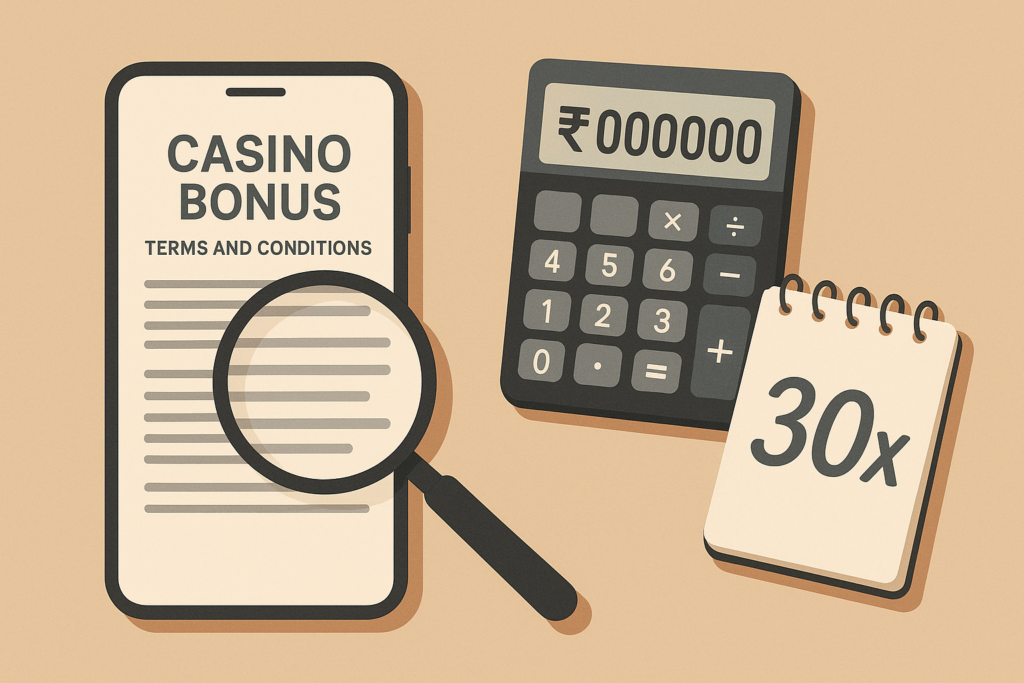
A wagering requirement is the amount you must bet before bonus money (or money won from it) can be withdrawn. Casino bonus wagering requirements are written as a multiplier: 30x, 40x, sometimes 50x or more. Get the multiplier, the base it applies to, the game weighting and the time limit, and you can work out in rupees whether an offer is worth claiming or not. Most players never do that math, which is exactly why the offers are designed the way they are.
This guide shows you how to do it in about five minutes per offer.
What are casino bonus wagering requirements?
Wagering requirements (also called playthrough, rollover or turnover requirements) are the total amount of bets you must place before bonus funds convert into withdrawable cash.
The worked example everyone should memorise:
- Bonus: ₹1,000
- Wagering requirement: 30x
- Total you must wager: ₹1,000 × 30 = ₹30,000
That ₹30,000 is turnover, not loss. If you bet ₹20 per spin, you need 1,500 spins to get there. Money you win along the way can be re-wagered, which is how a ₹1,000 balance can theoretically cover ₹30,000 of turnover.
The single most important detail in the fine print is what the multiplier applies to. Two versions exist:
- Bonus only: 30x on a ₹5,000 bonus = ₹150,000 turnover.
- Deposit + bonus: 30x on ₹5,000 deposit plus ₹5,000 bonus = 30 × ₹10,000 = ₹300,000 turnover.
Same headline number, double the work. A “35x bonus only” offer is usually easier than a “20x deposit + bonus” one, so never compare multipliers in isolation.
Casinos use playthrough requirements for a simple reason: without them, a matched deposit bonus would be free cash that players could withdraw immediately. The requirement makes sure the bonus is used for play, and because every game carries a house edge, extended play tilts the expected outcome back toward the operator.
That last point deserves a number. If you wager ₹150,000 on a slot with 96% RTP, the 4% house edge means your mathematically expected loss across that turnover is around ₹6,000 — more than the ₹5,000 bonus that triggered it. Real results swing widely either side of that average, but the expectation is the honest baseline. A bonus improves your position compared with playing without one; it does not create free money.
How game weighting affects your bonus clearing
Not every rupee you bet counts as a full rupee toward the playthrough requirement. Game weighting (sometimes called game contribution) sets the percentage each category contributes.
Typical weightings look like this, though every casino publishes its own table and you should check it before you play:
| Game type | Typical contribution | ₹1,000 wagered counts as |
|---|---|---|
| Slots (most titles) | 100% | ₹1,000 |
| Roulette | 10–20% | ₹100–₹200 |
| Blackjack / baccarat | 5–10%, often excluded | ₹50–₹100 or nothing |
| Video poker | 10–20%, often excluded | ₹100–₹200 |
| Live dealer tables | 0–10% | ₹0–₹100 |
| Jackpot slots | 0–100% (varies) | Check the table |
Slots vs table games: the weighting difference
Take a ₹150,000 playthrough requirement. On 100%-weighted slots, you need ₹150,000 of actual bets. On roulette weighted at 10%, you need ₹1,500,000 of bets to clear the same requirement — ten times the exposure to the house edge.
At ₹500 per roulette spin that’s 3,000 spins. At ₹20 per slot spin it’s 7,500 spins, but with a tenth of the turnover. The practical takeaway: if a bonus is built for slots, clear it on slots. If you mainly play Teen Patti, Andar Bahar or blackjack, a slots-weighted bonus may not suit you at all, and playing without a bonus can be the cleaner choice.
Why some games are excluded entirely
Casinos exclude games where the house edge is thin or where bet patterns can lock in low-risk outcomes. Low-edge blackjack variants, certain video poker paytables and games that let you cover most outcomes at once (betting red and black, or both sides of a baccarat table) are common exclusions. Many operators also exclude specific high-volatility bonus-buy slots.
Two things to watch here. First, bets on excluded games usually contribute zero, so you can grind for an hour and move nothing. Second, some terms go further and treat play on excluded games while a bonus is active as a breach, which can void the bonus and any winnings from it. Read that clause specifically.
Understanding max cashout and time limits
Max cashout is the ceiling on what you can withdraw from a bonus, no matter how much you win. It is the term that surprises players most.
Example: you claim a ₹1,000 no deposit bonus with 40x wagering and a ₹10,000 max cashout. You clear the ₹40,000 turnover and finish with ₹50,000 in your account. You withdraw ₹10,000. The remaining ₹40,000 is removed. The terms said so, and the casino is within its rights.
Max cashout is sometimes fixed (₹10,000) and sometimes a multiple of the bonus or deposit (5x bonus, 10x deposit). No deposit bonuses and free spins almost always carry a cap. Larger deposit bonuses sometimes have none — worth checking, because an uncapped 35x offer can be better value than a capped 25x one.
Time limits run alongside. Typical windows are 7 to 30 days from the moment the bonus is credited, and some free spins expire in 24 hours. Miss the deadline and the unmet bonus plus any winnings attached to it are forfeited; your own deposited cash is not affected, though it may be tied up until the bonus resolves.
Do the arithmetic before you accept. A ₹150,000 requirement over 7 days means roughly ₹21,400 of turnover a day. At ₹20 a spin that’s over 1,000 spins daily. If that pace only works by playing longer than you want to, or by betting more than you planned, decline the bonus. Chasing a deadline is how a bonus stops being entertainment and starts being a chore.
Red flags: spotting unfair bonus terms
Some welcome bonus terms are simply not worth the turnover. Watch for these:
- Wagering of 50x or more, especially on deposit plus bonus. A 60x requirement on a combined ₹10,000 base is ₹600,000 of turnover.
- Short windows on big requirements. 40x with a 7 day limit is a very different offer from 40x with 30 days.
- Very low max bet caps with harsh penalties. Caps of ₹100–₹500 per spin or round are normal; the problem is terms that void all winnings for a single accidental overspend. Some casinos block the bet instead, which is fairer.
- Excluded deposit methods. Many operators exclude certain e-wallets from bonus eligibility. Check whether your method — UPI, cards, wallets — qualifies before depositing.
- Max cashout below the bonus value in real terms, such as ₹5,000 cap on a bonus needing ₹200,000 of turnover.
- Vague “irregular play” or “bonus abuse” clauses with no definition, giving the operator wide discretion to void winnings.
- Terms you cannot find. If the full T&Cs are not linked from the promotion, treat that as the answer.
Also confirm KYC rules up front. Verification is standard and legitimate, but you want to know which documents are needed and whether the casino verifies before or only at withdrawal. Indian players should also remember that winnings from online gaming are taxable and TDS applies on net winnings, so the figure that lands in your bank is not always the figure on screen. Check current rates with a tax professional or the Income Tax Department.
How to compare two bonus offers (step-by-step)
Use the same five steps on every casino bonus in India and the bigger headline number stops being persuasive.
- Find the true turnover. Multiplier × base (bonus only, or deposit + bonus). Write the rupee figure down.
- Apply game weighting. If you want to play the games weighted at 10%, multiply the turnover by 10.
- Check the max cashout. Cap in rupees, or as a multiple of bonus/deposit. Uncapped is a real advantage.
- Divide turnover by the time limit. That gives daily turnover. Compare it with how you actually play, at your normal stake.
- Check the friction. Max bet, excluded games, eligible payment methods, whether the bonus is sticky or non-sticky.
Here is the comparison on a ₹5,000 deposit:
| Term | Offer A: 100% up to ₹10,000 | Offer B: 200% up to ₹10,000 |
|---|---|---|
| Bonus received | ₹5,000 | ₹10,000 |
| Wagering | 30x bonus only | 40x deposit + bonus |
| Total turnover | ₹150,000 | ₹600,000 |
| Time limit | 30 days | 7 days |
| Turnover per day | ₹5,000 | ₹85,700 |
| Max cashout | None stated | 5x bonus (₹50,000) |
| Max bet while active | ₹500 | ₹100 |
Offer B looks twice as generous and is roughly four times harder, with a ₹100 bet cap that makes ₹85,700 of daily turnover unrealistic for most players. Offer A is the better offer for almost anyone. This is why the framework matters more than the percentage on the banner.
Free spins vs deposit bonuses: different rules apply
Free spins are not a small deposit bonus. They usually run on a separate set of rules, and the differences are where players get caught out.
- Wagering applies to the winnings, not the spin value. If 50 spins produce ₹800 in wins with 40x free spins wagering, you must turn over ₹32,000.
- Spin value is fixed and often low, commonly ₹10 or ₹20, regardless of what you would normally bet.
- Game restriction is tighter. Free spins typically work on one named slot, not the whole slots library.
- Max cashout is usually lower than on deposit bonuses, and caps in the ₹1,000–₹5,000 range are common on no deposit spins.
- Expiry is faster. Spins may expire in 24 to 72 hours; winnings then get their own separate wagering deadline.
- Sticky vs non-sticky matters. With a sticky bonus you can only withdraw winnings generated from it; with a non-sticky bonus your real-money balance stays separate and withdrawable.
None of this makes free spins bad. Low-stake spins on a game you already like are a reasonable way to try a casino. Just price them for what they are: a small, capped, tightly restricted trial, not a route to a meaningful payout.
FAQ
What does a 30x wagering requirement mean?
It means you must place bets totalling 30 times the qualifying amount before bonus funds become withdrawable. On a ₹2,000 bonus that is ₹60,000 of turnover. Always check whether the 30x applies to the bonus alone or to deposit plus bonus, as that doubles or halves the work.
Do all games count equally toward wagering?
No. Slots usually count 100%, while roulette, blackjack, baccarat and live dealer tables often count 10% or less, and some games are excluded completely. The casino’s game weighting table in the T&Cs is the only authority on this.
What is max cashout on a bonus?
Max cashout is the maximum you can withdraw from bonus play, expressed as a fixed rupee amount or a multiple of the bonus or deposit. Winnings above the cap are removed when you request a withdrawal, even if you met every other condition.
How long do you have to meet wagering requirements?
Usually 7 to 30 days from when the bonus is credited, with free spins sometimes expiring within 24 to 72 hours. If the clock runs out, the bonus and any winnings tied to it are forfeited, so check the deadline before you claim rather than after.
A note on playing responsibly
Bonus terms can nudge you into playing faster, longer or at higher stakes than you intended, which is the opposite of controlled play. Every game has a house edge, so losses over time are the expected outcome and no bonus changes that. Set deposit, loss and session limits before you claim anything, treat the money as entertainment spend you can afford to lose, and use cool-off or self-exclusion tools if play stops feeling like a choice. Free, confidential support is available through organisations such as BeGambleAware. Online gambling is restricted to adults, and rules differ by Indian state.
For more on how deposits and withdrawals work alongside bonus terms, see our guide to casino payment methods in India, and our responsible gambling resources for limit-setting tools.