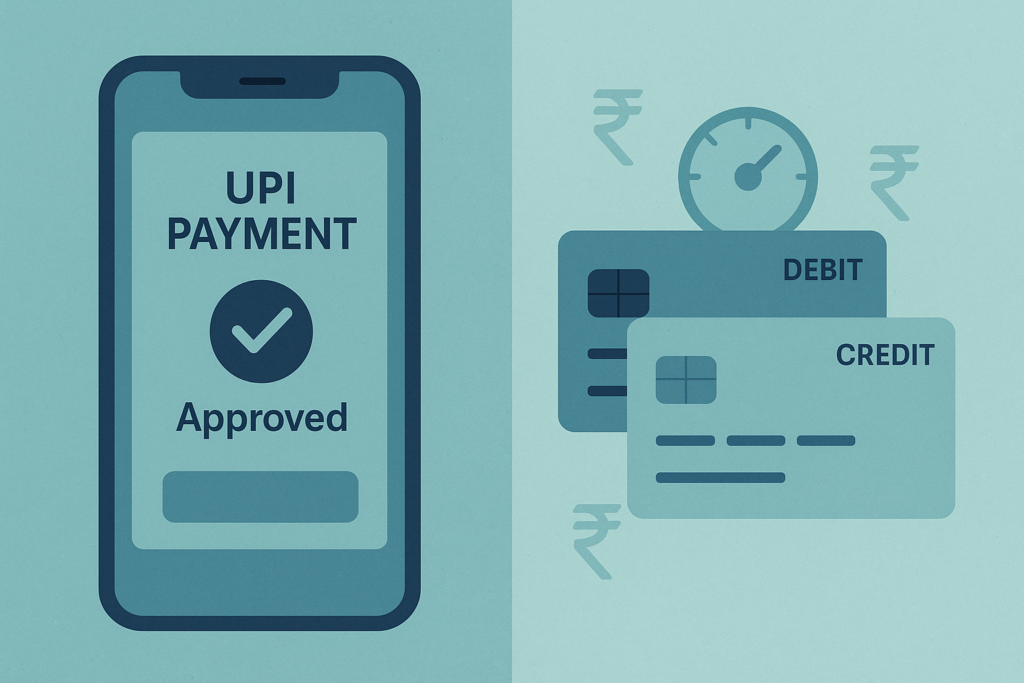
UPI vs Cards: quick comparison overview
For Indian players, UPI casino deposits India-wide are usually faster, cheaper and far less likely to be declined than card payments. UPI moves money bank-to-bank in seconds at zero cost to you, and it is the method most gaming sites also use for payouts. Cards, especially credit cards, get blocked often, can carry forex markups, and rarely support withdrawals at all.
Here is the practical comparison before we get into the detail.
| Factor | UPI | Debit card | Credit card |
|---|---|---|---|
| Deposit speed | Seconds to ~15 minutes | Instant to a few minutes when approved | Instant when approved, but high decline rate |
| Withdrawal support | Widely supported | Rarely offered; usually replaced by bank transfer | Almost never offered |
| Typical cost to you | Usually nil (zero MDR rail) | Possible forex markup + GST on that markup for overseas merchants | Forex markup, plus some issuers treat gambling merchants as a cash advance |
| Per-transaction limit | Commonly up to ₹1 lakh, bank-dependent | Your card’s daily online limit | Available credit, often with lower caps on high-risk merchants |
| Decline risk | Low to moderate | Moderate to high | High |
| KYC needed | Yes, before withdrawal | Yes, before withdrawal | Yes, before withdrawal |
One legal note first, because it changes how you should read everything below: real-money online gaming in India sits under central legislation passed in 2025 plus state laws that differ sharply from one another, and several states prohibit online gambling outright. Check what applies where you live before you move any money. This article explains how the payment rails work; it is not legal or tax advice.
How UPI casino deposits work in India
UPI is India’s instant bank-to-bank payment system, run by NPCI, and it settles 24×7 including weekends and holidays. When a gaming site offers UPI, you are not funding a wallet somewhere in the middle. Money leaves your bank account and lands with the operator’s collecting account, which is why it clears so fast.
UPI deposit process
- Open the cashier and choose UPI as the deposit method.
- Enter the amount. Most cashiers show a minimum (often a few hundred rupees) and a maximum per transaction.
- Either scan the QR code, pay to the VPA shown, or get a collect request pushed to your UPI app.
- Approve it in your app with your UPI PIN.
- Save the 12-digit UTR or reference number from the success screen. If the credit does not appear, that number is the only thing support can trace.
Two rules that trip people up: pay from a bank account in your own name, and pay only to the VPA or QR the cashier generated for that specific transaction. Paying from a friend’s or relative’s account is a third-party payment, and it will usually get your withdrawal frozen later at the verification stage.
Processing times and limits
The rail itself is near-instant. In practice, deposits show up in the account balance within seconds to about 15 minutes, with the delay coming from the operator’s payment provider reconciling the reference number rather than from UPI. Anything still missing after 30 minutes is a reconciliation issue, not a slow transfer.
NPCI’s standard cap for most UPI payments is ₹1 lakh per transaction, but your own bank may set a lower daily limit and also cap how many UPI transactions you can make in a day. Check the limits screen in your UPI app rather than assuming. Cashiers layer their own per-transaction minimums and maximums on top of that.
Card deposits and withdrawals: debit vs credit
Cards were the default casino payment method in India a decade ago. They are not any more, and the reason is bank-side blocking rather than anything the operator does. Gambling merchants are flagged with merchant category code 7995, and many Indian issuers decline that MCC by policy.
Debit card transactions
Visa and Mastercard debit cards are the ones most likely to be accepted, and RuPay is hit-and-miss with overseas merchants. A domestic card payment needs additional factor authentication, so expect an OTP step. Since RBI’s card-on-file tokenisation rules took effect, merchants cannot store your raw card number, so a token or a fresh entry is required each time.
Debit withdrawals are the real weak point. Most operators serving India do not push payouts back to a debit card; they ask for bank account details or a UPI ID instead. Where a card refund is used, it runs on the card networks and typically takes several business days to reflect.
Credit card considerations
Credit cards are the method I would avoid for this, for three concrete reasons. First, they are declined most often on gambling MCCs. Second, some issuers treat those transactions as cash advances, which means a fee plus interest accruing from day one with no grace period. Third, and most important: under Schedule I of the Foreign Exchange Management (Current Account Transactions) Rules, 2000, remittances for lottery, betting and similar purposes are prohibited, and the Liberalised Remittance Scheme cannot be used for them. Funding an offshore gambling merchant with an Indian credit card can put you on the wrong side of those rules. See the Reserve Bank of India for the current text of the FEMA rules and LRS FAQs.
Borrowed money is also the worst possible source of gambling funds. Every game on the site has a house edge, so the expected outcome over time is a loss, and paying credit card interest on top of that makes it worse.
Which payment methods are fastest for casino withdrawals in India?
UPI and direct bank transfer are the fastest options for online casino withdrawal India-side. Once an operator approves a payout, UPI credits in seconds; the total wait is normally 2 to 24 hours because of the internal review queue. Card refunds, where offered at all, typically take 3 to 5 business days. IMPS bank transfers usually land the same working day.
What actually determines payout speed is rarely the rail:
- KYC status. An unverified account is the single biggest cause of delay. Verified accounts clear far faster.
- First withdrawal. The first payout on an account gets the closest look. Later ones are usually quicker.
- Manual review windows. Some sites process payouts only during business hours, so a Friday night request can sit until Monday.
- Bonus conditions. Unmet wagering requirements or a max cashout cap will hold or cut a withdrawal regardless of method.
- Name match. The payout beneficiary name must match the account holder name. A mismatch means rejection, not just delay.
Fees and transaction limits breakdown
UPI transaction costs
UPI is zero-MDR in India by law, so there is no merchant discount rate for the receiving business and nothing to pass on to you. Banks do not charge retail customers for normal UPI payments. Your practical cost for a UPI deposit is zero. Some operators still advertise “no fees” as a feature; on UPI that is simply how the rail works. Limits are the constraint instead: commonly up to ₹1 lakh per transaction subject to your bank’s daily cap and transaction count, with cashier minimums often in the ₹100 to ₹500 range.
Card processing fees
Card costs are less predictable because they come from your issuer, not the casino. If the merchant is billed overseas, expect a foreign currency markup in the region of 1.5% to 3.5% depending on your card, with GST applied to that markup, and possibly a dynamic currency conversion spread if you are offered the choice of paying in rupees. Credit card cash-advance handling adds a flat fee plus interest from the transaction date. Read your card’s schedule of charges before assuming a card deposit is free.
The rough hierarchy of total cost, cheapest first: UPI, then net banking or IMPS, then debit cards, then credit cards.
KYC verification: what you need to know
KYC online casino checks exist because licensed operators are required under anti-money-laundering rules to confirm who you are, that you are of legal age, and that the payment instrument belongs to you. It also protects you: it is what stops someone else withdrawing to their own account after accessing your profile.
Required documents
- Government photo ID such as PAN card, Aadhaar, passport or driving licence
- Proof of address, usually a utility bill or bank statement no more than a few months old
- Proof of payment method: a bank statement header or screenshot showing your name with the account or UPI ID, or a masked card image showing only the first six and last four digits
- Sometimes a selfie or short liveness check
- Source-of-funds documents for larger withdrawals
Verification timeline
Most verifications complete in 24 to 72 hours when documents are clean, and some sites with automated checks finish in minutes. Rejections are usually mundane: blurred corners, cropped documents, a name spelled differently than on the account, or an address document that is out of date. Submit KYC as soon as you register instead of waiting for your first withdrawal, and you remove the most common cause of payout delay.
Withdrawals in India also carry tax consequences. Net winnings from online games are subject to TDS under the Income Tax Act, and deposits for online money gaming attract GST. Treat the exact rates as something to confirm with the Income Tax Department or a qualified professional.
Safety and security: UPI vs cards
Are UPI casino deposits safe? The rail is. UPI never exposes your account number to the merchant, every payment requires your UPI PIN on your own device, and it runs under RBI-supervised infrastructure. The weak point is the reversal path: UPI is a push payment, so once you approve it there is no chargeback mechanism like the card networks provide. Disputes go through your bank or PSP app, then NPCI’s dispute process, and unresolved digital payment complaints can escalate to the RBI Ombudsman.
Cards give you a formal dispute and chargeback route in theory, plus tokenisation and OTP authentication. In practice, disputing a gambling transaction you authorised yourself is difficult, and you have also handed card credentials to a third-party processor. Neither method protects you from the operator itself being untrustworthy.
Red flags worth walking away from, regardless of payment method:
- A cashier that asks you to send UPI money to a personal VPA or an individual’s phone number
- Requests to pay a “release fee” or extra tax before a withdrawal is processed
- Deposit methods that work instantly while withdrawals are “under review” indefinitely
- No verifiable licence details, no clear terms on withdrawal limits, or support that only exists on a messaging app
- Pressure to deposit again to unlock a pending payout
Common issues and solutions
Transaction failures
Failed deposits follow a short list of causes. If a card is declined with no OTP prompt, your issuer blocked the MCC, and retrying will not help. If UPI fails, check your daily limit, your app’s transaction count, and whether the collect request expired before you approved it. Money debited but not credited usually means a reconciliation gap: send support the UTR, the exact amount and the timestamp. If the merchant never received it, the bank auto-reverses debited UPI amounts, typically within a few working days.
Never solve a decline by borrowing someone else’s card or account. It creates an unfixable name mismatch later.
Withdrawal delays
Work through this order before assuming the worst: confirm KYC is fully approved, confirm any bonus wagering is cleared and you are within the max cashout, confirm the beneficiary name matches your ID exactly, and check whether the operator has a stated processing window. If a payout is still pending beyond the published timeframe, ask support for the payment reference and the specific reason for the hold, in writing.
Account blocks are usually triggered by duplicate accounts, third-party payments, a VPN masking your location, or age verification failures. Some are fixable with documents; some are not, which is a good reason to read the terms on payment ownership before your first deposit rather than after.
If you are comparing operators mainly on payout speed, our guide to online casinos in India covers what to check in the banking terms before you register.
A note on staying in control
Fast rails cut both ways. UPI makes it trivially easy to top up again in seconds, which is precisely why deposit limits, loss limits and cool-off tools matter more when you are using instant payments. Set a deposit cap in the account settings before you start, keep gambling money separate from money you need, and never fund play with credit. If it stops feeling like entertainment, use the self-exclusion tools and speak to a support service. Our responsible gambling guide lists the tools worth switching on from day one. Only adults of legal age should register.