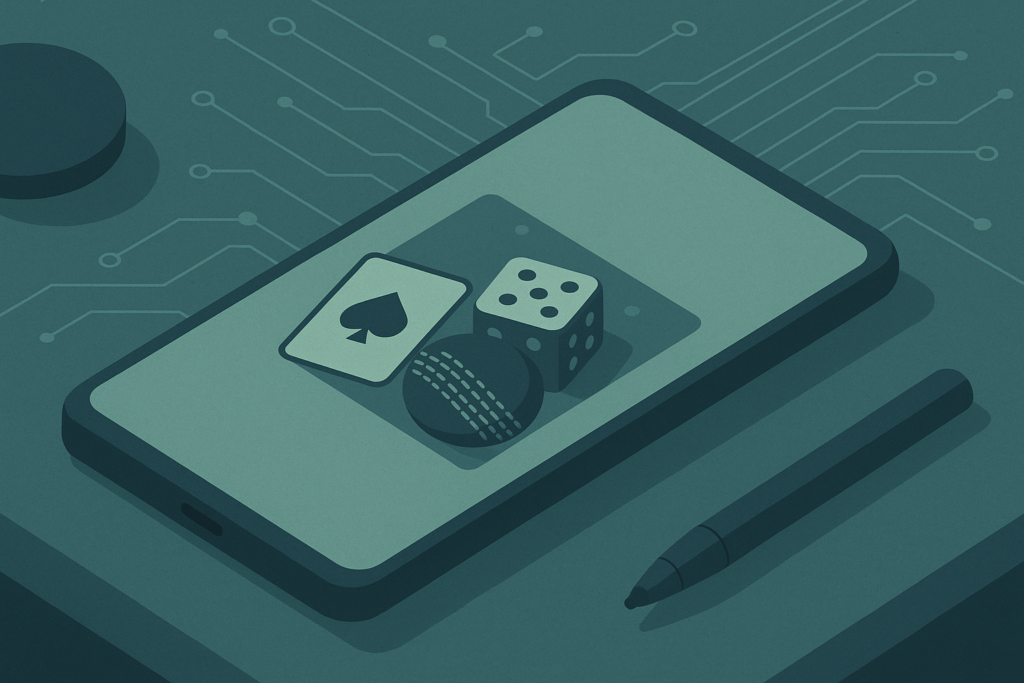
What does iGaming mean?
iGaming is gambling conducted over the internet: casino games, sports betting, poker and lotteries played through a website or an app instead of a physical venue. That’s the whole definition. If you understand what a betting shop or a casino floor does, you already understand what is iGaming — the activity is the same, the delivery is digital.
The “i” is a leftover from the early internet era, the same prefix that gave us email and iPhone-style naming. It stands for internet (some people say interactive). Wikipedia lists “iGaming” and “iGambling” as alternative names for online gambling, which tells you something useful: they are the same thing.
One thing that confuses newcomers is the word “gaming”. In India, “online gaming” can mean anything from a mobile puzzle app to a stake-based card game. iGaming specifically refers to real money games — where you risk money on an uncertain outcome. It’s mostly industry vocabulary, used by operators, regulators, software studios and trade press. Players themselves usually just say “online casino” or “betting app”.
Is iGaming gambling?
Yes. iGaming is gambling, full stop. Any activity with three ingredients counts: you stake something of value, the outcome depends at least partly on chance, and there’s a prize. Online slots, cricket bets and lottery tickets all tick those boxes whether you buy them at a counter or tap a screen.
What changes is the delivery method, and a few side effects of it:
- Outcomes are generated by software rather than a wheel, a shoe of cards or a coin toss, except in live dealer games where a real person deals on camera.
- Access is constant. No opening hours, no travel. That convenience is also the main risk factor for people who struggle to stop.
- Everything is logged. Every stake and result sits in your account history, which makes it easier to see what you’ve actually spent.
- Built-in controls exist. Licensed platforms offer deposit limits, session reminders and self-exclusion, tools a physical table can’t give you.
The maths doesn’t change either. Every commercial gambling product has a house edge, the operator’s mathematical advantage. A slot with 96% RTP (return to player) pays back about ₹96 per ₹100 staked averaged over millions of spins, leaving a 4% edge for the house. Over time, that edge is why the business is profitable and why players, collectively, lose. No format, strategy or app changes that.
Main types of iGaming games
Four categories cover nearly all real money iGaming. Here’s the quick comparison, then the detail.
| Category | Typical games | Outcome decided by | How the operator earns |
|---|---|---|---|
| Online casino | Slots, roulette, blackjack, baccarat, Teen Patti, Andar Bahar, crash games | RNG software, or a live dealer on stream | Fixed house edge built into the rules |
| Sports betting | Cricket, football, kabaddi, tennis, esports | Real-world results | Margin (overround) priced into the odds |
| Online poker | Texas Hold’em, Omaha, tournaments | Cards plus player decisions | Rake — a cut of the pot or entry fee |
| Digital lottery | State lotteries, number draws, instant-win tickets | Random draw | A share of ticket sales held back from the prize pool |
Online casino games
This is the biggest slice. Slots dominate by volume, with published RTPs usually in the 94–97% band and volatility that ranges from steady small wins to long dry spells punctuated by rare big ones. Volatility describes how wins are spread out; it does not change RTP. Alongside slots sit the table classics — European roulette carries a 2.7% house edge, American roulette 5.26% because of the extra double zero — plus live dealer studios streaming blackjack, baccarat, Teen Patti and Andar Bahar with real croupiers. Crash games such as Aviator are a newer format where a multiplier climbs from 1.00× and you must cash out before it crashes.
Sports betting
You stake on a real event: who wins the match, how many runs in an over, which team takes the toss. Cricket drives most Indian interest, with football, kabaddi and tennis behind it. Prices are usually shown as decimal odds — 2.00 returns ₹2 per ₹1 including your stake, implying a 50% chance (1 ÷ 2.00). Bookmakers add a margin across every market, so the implied probabilities of all outcomes add up to more than 100%. That gap is their edge.
Online poker
Poker is different from the rest because you’re playing other people, not the house. The platform takes a rake — a small percentage of each pot or a tournament entry fee — regardless of who wins. Skill genuinely matters over a large sample, but variance is brutal in the short run, and Indian courts have spent years arguing about where skill ends and chance begins in card games played for stakes.
Digital lotteries
Lotteries were first online, actually: ticketing for the Liechtenstein International Lottery opened to the public in October 1994, which is generally treated as the start of internet gambling. Today they cover state-run draw games sold through authorised digital channels and instant-win scratch-style tickets. The prize pool is a fixed share of sales, so the edge is baked in before a single ticket is sold.
How does iGaming work?
An online casino or betting site looks like one company but is normally a stack of several. The brand you log into handles your account and money; the games themselves are usually made and hosted by other businesses entirely.
iGaming operators vs game providers
An operator is the company that runs the site or app: it holds the licence, registers players, verifies identity (KYC), processes deposits and withdrawals, sets bonus terms and pays out. This is what people mean by an “iGaming company”, though the label also gets used for suppliers and affiliates.
A game provider (or studio) builds the actual games, runs them on its own servers and sells access to operators, often through an aggregator that bundles thousands of titles into a single integration. That’s why the same slot appears on dozens of unrelated sites with identical maths. Microgaming, an Isle of Man company, developed the first fully functional gambling software in the mid-1990s, with transaction security from CryptoLogic — the operator-plus-supplier split dates back that far.
Two more layers sit underneath: payment providers moving money (in India, typically UPI and bank transfers), and testing labs plus regulators who certify that games behave as advertised.
Random number generators (RNG)
An RNG is the algorithm that decides each outcome. When you press spin, the software requests a number, maps it to a reel position or card, and that’s your result. Two points matter. First, each round is independent: there are no hot or cold machines, and a slot that hasn’t paid in 200 spins is no more “due” than one that just paid. Second, RNGs in regulated markets are tested by independent labs to confirm the distribution is random and the RTP matches what’s published.
Some newer games, especially crash titles, use a provably fair system instead: server and client seeds are hashed so you can verify after the round that the result wasn’t altered. Verifiable randomness is not the same as favourable odds — the house edge is still there by design.
Is iGaming legal in India?
It’s complicated, it varies, and this is general information rather than legal advice. Get advice from a qualified Indian lawyer before acting on anything here.
The starting point is constitutional: “betting and gambling” is a State List subject, so each state can write its own rules, on top of the colonial-era Public Gambling Act of 1867 which predates the internet entirely. The result is a patchwork:
- Goa permits licensed casinos in five-star hotels and on offshore vessels.
- Sikkim has a licensing regime for certain online games and lotteries offered within the state.
- Nagaland licenses specified games of skill played for stakes.
- Several states, including Telangana, Andhra Pradesh and Tamil Nadu, have legislated against stake-based online games; some of those laws have been challenged in High Courts, with mixed outcomes, and litigation has continued for years.
The bigger change is at the central level. Parliament passed the Promotion and Regulation of Online Gaming Act in 2025, which prohibits online money gaming services nationwide while supporting esports and non-stake social games. It has been challenged in court, and the practical picture for players and operators has been shifting since. Anyone reading this should check the current position rather than rely on an article’s snapshot.
Separately, winnings from online games are taxable in India, with tax deducted at source on net winnings. Treat that as informational and speak to a tax professional about your own situation.
The iGaming industry today
Various estimates put global online gambling at roughly $40 billion a year in revenue. A large share of licensed activity is registered in a handful of jurisdictions — Malta, Gibraltar and Alderney in Europe, the Philippines through PAGCOR in Asia — while regulators like the UK Gambling Commission and US state bodies such as the Pennsylvania Gaming Control Board oversee their own markets. Many operators base themselves in low-tax jurisdictions close to their customer base.
Technology, not marketing, explains most of the growth. Cheap mobile data and smartphone-first design moved the whole category from desktop to phone. Live dealer studios turned video streaming into a product. Instant payments made deposits and withdrawals a matter of minutes rather than days. India shows all of those trends clearly: a young, mobile-heavy, UPI-native audience, which is exactly why the regulatory debate here has been so intense.
A note on playing responsibly
iGaming is entertainment with a built-in cost, not a way to make money. The house edge means the expected long-run result for players is negative, so the only sensible budget is money you can afford to lose entirely. Set deposit and loss limits before you start, never chase losses, and use cool-off or self-exclusion tools if play stops feeling like a choice. Online real money gambling is strictly for adults 18 and over, and free help is available from professional support services if it becomes a problem.
FAQ
Is iGaming the same as gambling?
Yes. iGaming is gambling delivered over the internet. The stake, the element of chance and the prize are identical to offline gambling; only the channel differs.
How does iGaming work?
An operator runs the site, holds the licence and handles accounts and payments. Game providers build and host the games, whose outcomes come from tested random number generators or live dealers on stream. Payment processors move the money.
What is an iGaming company?
Usually an operator: the licensed business running a casino or betting brand. The term also covers game studios, platform and aggregator suppliers, payment firms and affiliates that work in the sector.
Is iGaming legal in India?
There is no single yes or no. Gambling is a state subject with very different rules across states, and Parliament’s 2025 online gaming law prohibits online money gaming at the central level, subject to ongoing litigation. Check the current legal position for your state and consult a lawyer.
Does a higher RTP mean I’ll win?
No. RTP is a long-run average across millions of rounds, not a session outcome. A 96% RTP game still carries a 4% house edge, and individual results stay unpredictable.