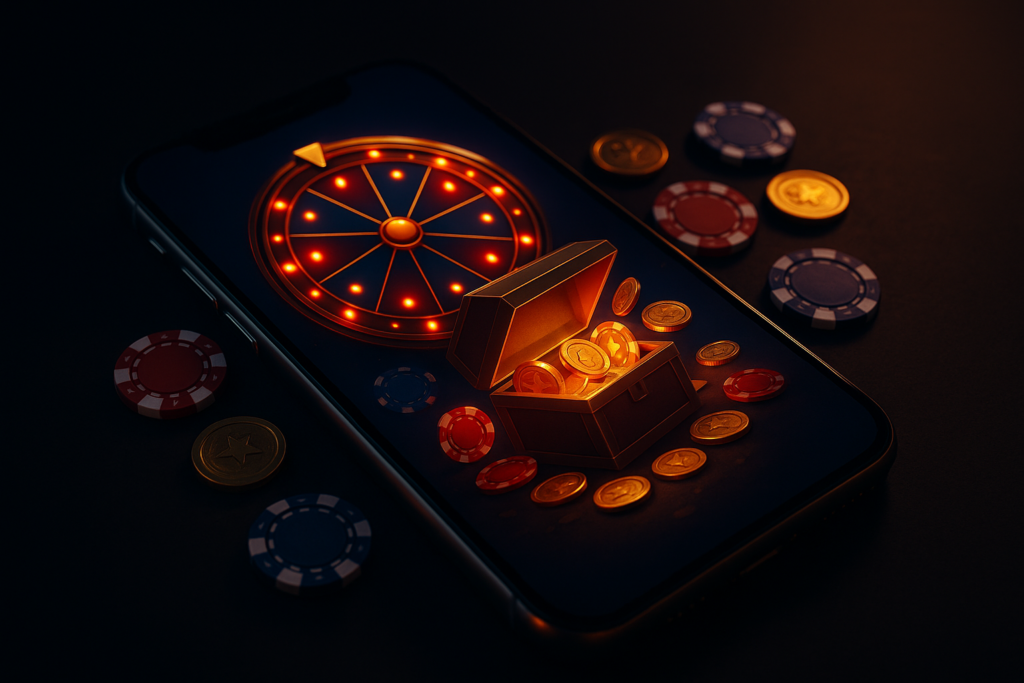
What are gambling-like mechanics in games?
Gambling-like mechanics in games are paid or earned features where you commit something of value and receive a randomised reward. That’s the one-line definition. The complication is that almost nothing about it is simple: the “value” might be real money, an in-game currency bought with real money, or just your attention; the “reward” might be a cosmetic hat worth nothing outside the game; and the company running it is usually not licensed as a gambling operator and insists it isn’t one.
You’ll find these mechanics in shooters, football games, mobile puzzle titles, fitness apps, shopping apps and food delivery apps. The usual suspects:
- Loot boxes — sealed crates, packs or chests containing random items, bought with currency or won through play.
- Gacha pulls — the mobile equivalent, where you spend currency on a random “pull” from a pool of characters or gear, often with published drop rates.
- Spin-to-win wheels — a wheel or slot-style reel that lands on a prize, discount or bonus.
- Mystery boxes and surprise bags — the retail version, where you pay a fixed price for unknown contents.
- Streak and daily login rewards — escalating bonuses that punish you for missing a day.
None of these is automatically predatory. A free daily wheel that hands out a small discount is a marketing gimmick. A £4.99 pack with a 0.6% chance of the item you actually want, sold to a fourteen year old with a saved card, is a different animal. The mechanic is the same; the design intent and the price tag are not.
Myth: “It can’t be gambling if you always get something”
This is the industry’s favourite line, and it’s the weakest. Yes, every loot box contains something. So does every scratchcard that returns 10p on a £2 stake. What matters to the player’s brain is not whether the box is empty but whether it contains the thing they paid to chase.
The random reward system
Open a pack in a football card game and you’ll typically get several low-value commons plus a small chance at something rare. The expected value of the pack sits comfortably below what you paid, which is exactly how a house edge works in a casino: the operator prices the average outcome in its own favour. The difference is that a licensed casino has to publish RTP figures and be audited on its random number generator, while many games publish nothing at all about their drop rates.
The reinforcement pattern is the important bit. Psychologists call it variable ratio reinforcement: rewards arrive after an unpredictable number of attempts. It is the same schedule that makes slot machines so sticky, and it produces more persistent behaviour than a predictable reward ever does. If every tenth box guaranteed the rare item, players would open ten boxes and stop. Because nobody knows which box it’s in, they keep going.
Why they feel addictive
Brain imaging research into reward has repeatedly found that anticipation of an uncertain reward, not just the reward itself, is associated with dopamine activity. That’s why the animation matters so much. Game designers stretch the moment of uncertainty: the crate wobbles, the light beam changes colour, the reels slow down to a near miss. The outcome was decided the instant you clicked. The three seconds of theatre exist purely to extend the anticipation.
Layer on the other standard tricks and the pull gets stronger: limited-time banners that create urgency, “pity timers” that guarantee a rare drop after a set number of failed pulls (which also tells you exactly how much further to spend), and social display, because a rare skin is worthless unless other players can see it. Multiple studies have found an association between heavy loot box spending and problem gambling severity. Association, not proof of cause, and researchers argue over the direction. But the correlation has been replicated often enough that “coincidence” is no longer a serious answer.
The mechanics you’ll actually meet
Spin-to-win wheels
In-app spin mechanics work like a prize wheel with weighted segments. The jackpot slice looks the same size as the others on screen but is weighted to land rarely, and the pointer often glides past it before settling one slot short. That near miss is deliberate. In non-gaming apps, spins are usually free and paid for with your data, your attention or a share prompt (“invite a friend for another spin”). In games, extra spins cost currency, and currency costs money.
Mystery box systems
Mystery boxes take the loot box logic and attach it to physical goods or tradeable items. Where the contents can be resold — on a marketplace, a skin trading site or a grey market — the reward acquires a cash value, and that is precisely the threshold most gambling law cares about. It’s also where third-party skin betting sites, which sit entirely outside any game’s own age checks, attach themselves.
Daily login rewards
Not random, not a wager, but worth understanding because they build the habit the random mechanics then monetise. A seven day escalating ladder that resets to zero if you miss a day manufactures a small daily obligation. Combine it with a limited-time event and a shop refresh, and the app has given you a reason to open it every single day. That’s the engine; loot boxes are what’s bolted to it.
Gaming vs gambling: where the line actually sits
Legally, most gambling definitions need three things: a stake, an element of chance, and a prize of real-world value. Loot boxes clear the first two comfortably. The argument is almost always about the third. If the rare item can’t legally be cashed out, publishers say there’s no prize of value, and in many jurisdictions courts have agreed.
| Feature | Licensed gambling | Loot box / spin wheel in a game |
|---|---|---|
| Stake | Real money | Real money, usually via in-game currency |
| Outcome | Random, RNG-audited | Random, rarely independently audited |
| Odds disclosed | Required in regulated markets (RTP) | Only where platform or local rules force it |
| Cash out | Yes | Officially no; sometimes yes via grey markets |
| Age verification | Mandatory ID checks | Usually a self-declared birthday |
| Oversight | Gambling regulator, licence conditions | Consumer and app store rules, mostly self-regulation |
The honest summary: these mechanics are structurally close to gambling and legally, in most places, not gambling. That gap is the whole controversy.
Why regulators and advocates are concerned
The word doing the work in policy circles now is gamblification — the drift of betting-style design into products that never called themselves gambling. Belgium’s Gaming Commission concluded in 2018 that paid loot boxes met its definition of a game of chance, and major publishers pulled them from the Belgian market. The Netherlands went after football card packs, only for the Dutch highest administrative court to annul the regulator’s fine in 2022 on the basis that the packs were part of a wider game rather than a standalone game of chance. The UK government’s response to its loot box call for evidence stopped short of new legislation and pushed for industry-led protections instead.
Transparency has moved further than prohibition. China has required publishers to disclose drop rates since 2017, Apple’s App Store rules require apps to publish the odds of randomised items, and both ESRB and PEGI now flag in-game purchases that include random items.
The support sector has been blunter than the regulators. GamCare, the UK charity behind the National Gambling Helpline, has argued that gambling harm can no longer be treated as the licensed betting industry’s problem alone, and has called for a cross-industry approach that takes in gamified and gambling-adjacent products. The concerns are consistent: children reach these mechanics with no meaningful age check, spend is fragmented into small transactions that are hard to track, and the odds are often simply unknown.
How to spot these mechanics
Before you or your child installs something, look for these signals:
- The store page label. “In-app purchases (includes random items)” is the clearest single tell.
- A currency between you and the price. Gems, coins and tokens exist to blur what things cost. If a pack costs 850 gems and gems sell in bundles of 500 and 1,200, that’s deliberate.
- Published drop rates — or their absence. Rates in the fine print are a decent sign. No rates anywhere is a red flag.
- Opening theatre. Long reveal animations, spinning reels, near misses and slow-building light effects all point at engineered anticipation.
- Countdown timers on rare items. Scarcity applied to a random reward is pressure selling.
- Trading or marketplace features. Once items have resale value, the mechanic is functionally closer to real-money gambling.
- Streaks with harsh resets. A habit loop designed to make skipping a day feel like a loss.
Protecting yourself and your family
Practical steps, roughly in order of usefulness:
- Turn off saved payment details and require a password or biometric check for every purchase. Both iOS and Android support this, as do the main console family settings.
- Use platform family controls to set a spending cap per week or month, and check the purchase history rather than trusting recall. Small transactions add up quietly.
- Prefer gift cards to a linked card for younger players. A fixed balance is a natural limit.
- Talk about odds in concrete terms. “A 1% drop rate means roughly one in a hundred pulls” lands better than “don’t waste your money”.
- Watch for warning patterns: chasing a specific item after repeated failures, hiding spending, borrowing money to buy currency, irritability when the app is unavailable, or purchases that no longer match what the player can afford.
If spending on these mechanics has stopped feeling like a choice, that’s worth treating seriously rather than shrugging off as “just a game”. National gambling helplines and charities support people worried about gambling-style spending in games, not only about betting. Our responsible gambling guide covers deposit limits, cool-off periods and self-exclusion tools, and our addiction awareness resources explain what early warning signs look like in practice.
FAQ
Are loot boxes gambling?
Structurally they behave like it: a stake, a random outcome and a variable reward. Legally it depends on jurisdiction and on whether the contents have real-world value. Belgium concluded that paid loot boxes were games of chance; Dutch courts reached the opposite conclusion about football card packs; the UK opted for industry-led measures rather than legislation.
Why are spin wheels addictive?
Because the reward schedule is unpredictable and the presentation stretches the uncertainty. Weighted segments, near misses and slow-settling pointers keep attention on the moment before the result, which is where the anticipation sits.
How do I find out the odds of a loot box?
Check the in-game shop’s information or help screens, the app store listing, and the publisher’s support pages. Apple’s rules require odds disclosure for randomised items, and some markets mandate published drop rates. If you can’t find rates anywhere, assume the rare outcome is rarer than it feels.
Do these mechanics lead to gambling later?
Research has found associations between heavy loot box spending and problem gambling severity, but the causal direction is still debated. The reasonable position is that the mechanics teach familiarity with randomised spending, which is a good reason for caution with under-18s rather than proof of a pipeline.