Regulation is not a one-way door
The comfortable assumption in this industry is that once a country legalises betting, the argument is over. Licences get issued, taxes start flowing, and the market settles into something permanent. Brazil is the clearest evidence that this is wrong. Less than two years after the country opened one of the largest regulated betting markets on earth, President Luiz Inácio Lula da Silva is reportedly weighing far tougher measures on the sector, according to reporting by SBC News. Nothing has been enacted. But the fact that a sitting president is openly considering it is the story.
Brazil betting regulation is worth following closely even if you never place a real on a Brazilian site, because the sequence playing out there is the sequence every newly regulated market eventually faces: legalise, license, tax, then panic about social cost. Understanding how that arc affects operators, payments and ordinary player accounts is more useful than any prediction about what Lula will actually sign.
How Brazil built the market it is now questioning
Follow the process from the beginning and the pressure points become obvious.
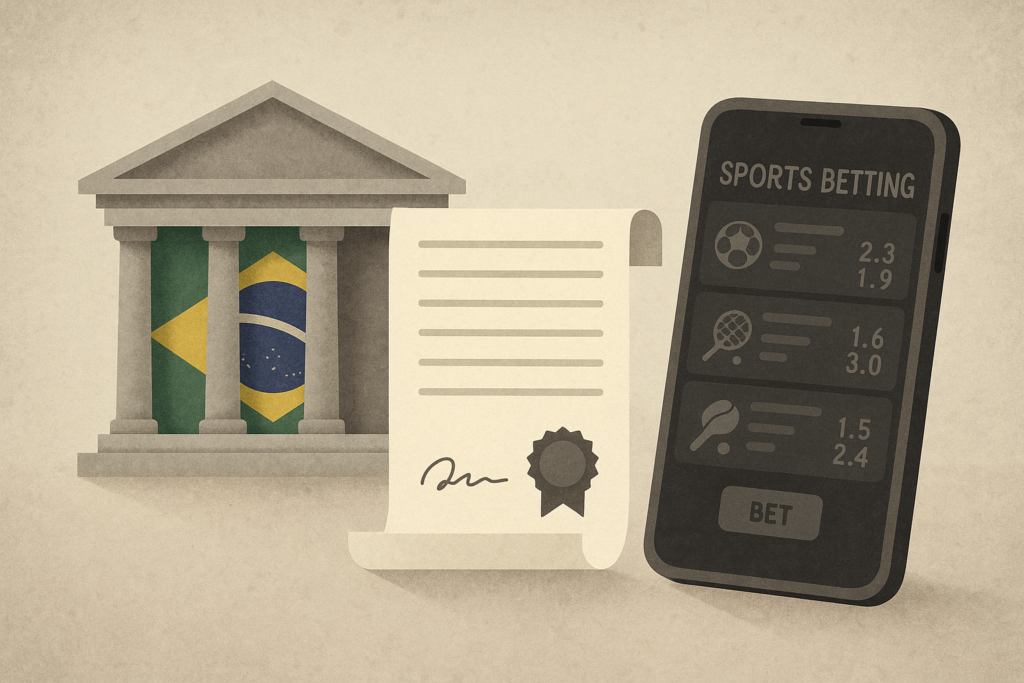
Brazil legalised fixed-odds betting in principle back in 2018, then spent years doing nothing with it. The framework that actually matters is Law 14.790 of 2023, which set the terms for a licensed online betting and casino market and handed supervision to the Secretariat of Prizes and Betting (SPA) inside the Ministry of Finance. The regulated market went live at the start of 2025.
The entry terms were deliberately steep. A federal licence runs five years and costs R$30 million, covering up to three brands per licence holder. Licensed operators pay 12% of gross gaming revenue in tax, plus the usual corporate obligations. Every legal site sits on a .bet.br domain, so a player can check legality by looking at the address bar. Accounts must be tied to the player’s CPF, the national tax ID, and credit card deposits are off the table.
That design did two things at once. It pulled a huge, previously offshore-served audience onto licensed, traceable platforms. And it created a sector large and visible enough to become a political target, with advertising on football shirts, television and social feeds that no politician could miss.
The turn: why a legal market gets reopened
Reversal pressure rarely comes from the regulator. It comes from politics. In Brazil the recurring complaints have been about household debt, low income players spending welfare money on betting, and the sheer volume of advertising aimed at a football-obsessed public. Congressional inquiries and central bank commentary kept the subject alive through the market’s first year. Once a head of state starts asking whether the whole thing was a mistake, the range of options on the table widens dramatically.
What has actually been reported so far is that Lula is considering drastic measures. The specifics have not been confirmed, and no reader should treat speculation about a ban as a done deal. What can be said with confidence is which levers a government has when it decides a legal betting market needs reining in, because the same short list appears everywhere from Italy to the Netherlands to India.
The standard menu of restrictions
These levers differ enormously in how fast they bite and who feels it first.
| Policy lever | What it changes | Practical effect on players |
|---|---|---|
| Higher GGR or turnover tax | Operator margin shrinks | Worse odds, thinner promotions, smaller game lineups |
| Advertising and sponsorship bans | Acquisition channels close | Fewer bonus offers; brands become harder to distinguish from illegal ones |
| Product restrictions (stake caps, game bans, deposit limits) | Certain verticals or bet sizes disappear | Familiar games or bet types vanish overnight |
| Payment blocking | Banks and processors cut off flagged sites | Deposits fail, withdrawals stall pending compliance checks |
| Licence freeze or revocation | Operators lose the right to serve the market | Accounts closed, balances returned through a wind-down process |
| Full prohibition | Legal market ends | Demand migrates offshore, with no local recourse |
What a clampdown looks like from inside a player account
This is the part most coverage skips. Take a hypothetical Brazilian punter with a verified account on a licensed .bet.br operator, a small balance, and an open multiple on a Série A weekend. Trace what each scenario does to him.
- Tax rises. Nothing visible happens on day one. Over months the margin on his football markets widens, free bet offers get stingier, and the operator quietly drops low margin products. His experience degrades without a single announcement.
- Advertising ban. His inbox goes quiet. Sponsorship logos disappear. The practical risk is that legitimate brands become less recognisable, which historically helps unlicensed sites that ignore the rules anyway.
- Product limits. A stake cap or a ban on a specific vertical means his usual bet simply cannot be placed. Open positions are normally honoured, but new ones are blocked from the effective date.
- Payment blocking. Deposits start failing at the bank layer. Withdrawals often still process, but slower, with extra verification. This is the stage at which players get nervous and start looking for workarounds.
- Licence withdrawal or prohibition. The operator must stop taking bets and return player funds. A well supervised wind-down, with segregated player money and a regulator overseeing repayment, is the difference between a delay and a loss. Offshore sites offer no equivalent.
The lesson from the walkthrough is that the damage is rarely the dramatic headline. It is the slow erosion of value and the sudden friction in payments, both of which push players toward sites with no consumer protection at all.
The channelisation problem nobody escapes
Every restriction has a second order effect: it changes how much of the market stays inside the licensed perimeter. Regulators call this channelisation. Push taxes and restrictions far enough and you keep the social harm while losing the tax revenue, the KYC trail, the deposit limits and the self-exclusion tools. That is not an industry talking point, it is the consistent finding of regulators who have tried the strictest settings and had to loosen them again.
India has already run its own version of this experiment. Individual states banned online money games years before the central government legislated, and the 2025 federal law on online gaming reset the picture again, leaving operators, payment providers and players to work out what is permitted where. Anyone who watched that happen will recognise the Brazilian pattern immediately: a market can be legal, taxed and mainstream one quarter and in question the next.
How to read policy risk before it reaches your account
You cannot forecast legislation, but you can notice the warning signs and keep your exposure small.
- Watch the finance ministry, not the headlines. Tax and payment rules do more damage, faster, than any proposed ban that never passes.
- Check licensing at the source. In Brazil that means the SPA authorisation and a
.bet.brdomain, not a logo in a site footer. - Do not park money on a platform. Keep balances at the level you intend to bet, withdraw the rest, and finish your KYC before you need it. Verification delays always get worse during a regulatory squeeze.
- Read the terms on account closure. A clear wind-down and fund return clause tells you how the operator behaves if it loses its licence.
- Treat offshore migration as a downgrade, not a workaround. Leaving a regulated market means giving up dispute resolution, segregated funds and enforceable limits.
None of this changes the underlying maths. Every betting product carries a built-in house edge, and regulation only determines whether that edge is applied transparently, taxed properly and wrapped in genuine player protections. Brazil’s current wobble is about which of those safeguards survive the politics.
If betting has stopped being entertainment for you, use the deposit limits, cool-off and self-exclusion tools your operator is required to provide, and contact a local support service. Those tools exist inside regulated markets, which is precisely what is at stake when a government reaches for the prohibition lever.