

Cricket betting odds are just probability written as a number you can multiply your stake by. When a bookmaker prices Mumbai Indians at 1.80 to win a match, that number is doing two jobs at once: it tells you the bookmaker’s estimate of how likely that result is (about 55%), and it tells you what you’d get back if it happened (₹1.80 for every ₹1 staked, stake included). Understand those two jobs and most of the confusion around betting markets disappears.
This guide covers how cricket betting odds work, how to read decimal odds, what the main markets actually mean, and where the bookmaker’s built-in margin sits. It’s an explainer on the mechanics, not a tipping service. There is no system that beats a priced market over time, and the maths below shows exactly why.
How cricket betting odds work
What odds actually mean
Odds are a bookmaker’s implied probability, plus a margin, expressed as a payout multiplier. The conversion is one division:
Implied probability = 1 ÷ decimal odds
So odds of 2.00 imply 1 ÷ 2.00 = 0.50, or a 50% chance. Odds of 1.25 imply 80%. Odds of 5.00 imply 20%. Nothing mystical about it, and the direction is always the same: the shorter the odds, the more likely the bookmaker thinks the outcome is, and the smaller the payout.
Two things worth being clear on. First, implied probability is the bookmaker’s opinion, shaped by pricing models and by where the money is going, not a fact about the match. Second, it’s inflated slightly above the “true” estimate because of the margin, which is how the business makes money. More on that below.
Decimal vs fractional formats
Decimal odds are the standard display format on almost every betting site used in India, and they’re the easiest to work with. Fractional odds (the 5/1, 1/2 style still common in British racing) show profit relative to stake rather than total return.
Converting between them takes one step: decimal = fraction + 1. So 5/1 becomes 6.00, and 1/2 becomes 1.50. An even-money price is 1/1 in fractions and 2.00 in decimals. American odds (+150, −200) turn up occasionally but are rare in a cricket context.
Reading decimal odds: a step-by-step guide
Calculating your potential payout
Two formulas, and that’s the whole job:
- Total return = stake × decimal odds
- Profit = total return − stake
A ₹500 stake at 1.80 returns ₹900 in total: ₹400 profit plus your ₹500 back. The same ₹500 at 3.50 returns ₹1,750, or ₹1,250 profit. If the bet loses, the stake is gone; that’s the other half of the equation and the half that gets skipped in most explanations.
Here’s how a range of realistic cricket prices translates, using a ₹1,000 stake for comparison. These are illustrative figures, not live prices.
| Decimal odds | Implied probability | Return on ₹1,000 | Profit |
|---|---|---|---|
| 1.20 | 83.3% | ₹1,200 | ₹200 |
| 1.50 | 66.7% | ₹1,500 | ₹500 |
| 1.80 | 55.6% | ₹1,800 | ₹800 |
| 2.00 | 50.0% | ₹2,000 | ₹1,000 |
| 2.50 | 40.0% | ₹2,500 | ₹1,500 |
| 4.00 | 25.0% | ₹4,000 | ₹3,000 |
| 7.00 | 14.3% | ₹7,000 | ₹6,000 |
Favourites vs underdogs in odds
The favourite is simply the side with the shortest odds. In a T20 between a strong home side and a bottom-of-the-table opponent, you might see 1.45 against 2.75. The 1.45 side is the favourite at roughly 69% implied probability; the 2.75 side is the underdog at roughly 36%.
Notice that big payouts and likely outcomes are opposite ends of the same scale. A 7.00 price pays six times your stake precisely because the market thinks it comes in about one time in seven. Long odds are not “value” on their own, and short odds are not “safe” — Test cricket and T20 both produce results that the market priced at 10.00 or worse. The price describes expectation, not certainty.
Main cricket betting markets explained
Cricket carries more markets than almost any other sport because every ball generates data. The categories below cover the bulk of what you’ll see on an IPL or international fixture.
Match result markets
The core market is the match winner: two prices in a limited-overs game, three in a Test where a draw is possible (and occasionally a tie price in first-class cricket). Related result markets include the series winner, the toss winner (a genuine 50/50 before the margin is applied), and outright markets like the IPL title or the World Cup winner, which stay open for weeks.
Handicap markets adjust for a mismatch by giving one side a runs or wickets start, so a lopsided fixture produces closer prices. Live betting, sometimes called in-play, reprices the same market ball by ball as the run rate, wickets and required total change.
Player performance markets
These price individuals rather than teams:
- Top batter — most runs for a team in the innings. Openers are usually shortest because they’re guaranteed to bat, while a number six might be priced long partly because he may not get an innings at all.
- Top bowler — most wickets for a side, with dead-heat rules applying when several bowlers tie.
- Player runs or wickets over/under — for example, over 24.5 runs for a specific batter.
- Method of dismissal — caught, bowled, LBW, run out, or not out. Caught is historically the most common dismissal in cricket, which is why it’s normally the shortest price in this market.
- Player of the match — settled on the official award, which is a judgement call rather than a pure statistic.
Runs and overs markets
Totals markets ask whether a number will be exceeded, not who wins. Common versions include total match runs over/under, runs in the first six overs (the powerplay), runs off a specific over, total sixes, total fours, and highest opening partnership. A line such as “over 165.5 runs” exists with the half-run so the bet cannot end level.
Pitch and venue matter enormously here. A total set for a high-scoring ground looks nothing like one set for a slow, turning surface, and the line moves as soon as the toss and team sheets are known.
Understanding the bookmaker margin
Add up the implied probabilities of every outcome in a market and you’ll get more than 100%. That excess is the bookmaker margin, also called the overround, and it’s the reason betting has a negative expected value over time.
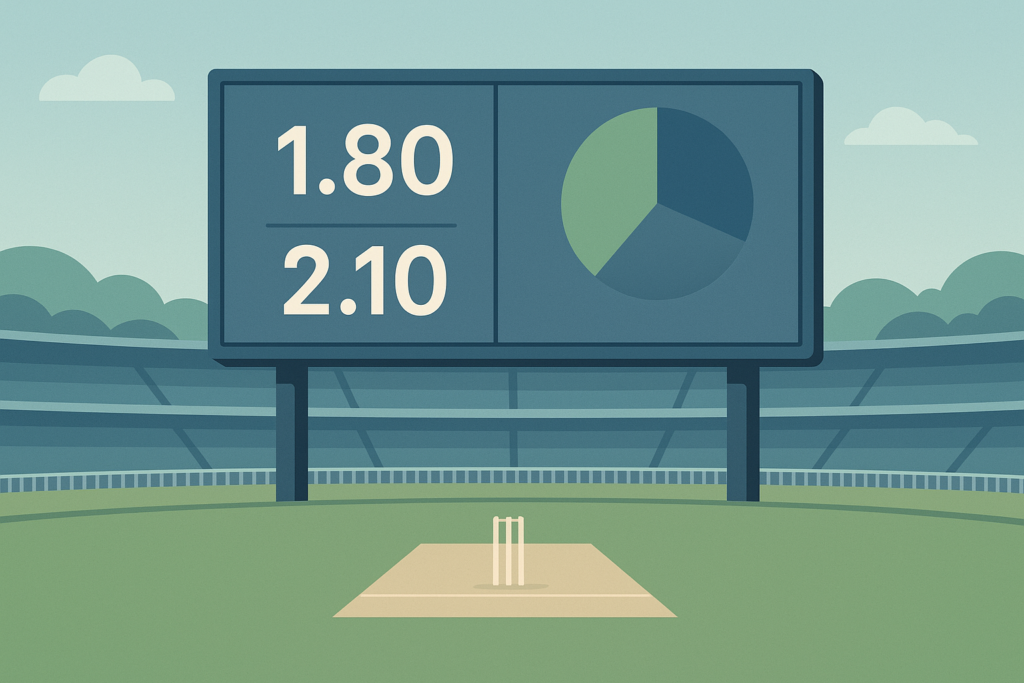
Take a two-way match market priced at 1.80 and 2.10:
- 1 ÷ 1.80 = 55.6%
- 1 ÷ 2.10 = 47.6%
- Total = 103.2%
The margin is 1 − (1 ÷ 1.032) ≈ 3.1%. A genuinely fair 50/50 market would be 2.00 and 2.00; the bookmaker’s version shaves a little off both prices. Over thousands of bets, that shave is the operator’s revenue — the sports betting equivalent of the house edge on a casino game.
Margins vary a lot by market. Headline match odds on a big fixture are often the tightest prices on the site, while niche markets carry considerably more. A three-way Test market at 2.20 (home), 3.40 (away) and 3.60 (draw) totals 45.5% + 29.4% + 27.8% = 102.6%, a margin of about 2.5%. A method-of-dismissal market with five options can easily run several times higher. The practical takeaway is simple: the more obscure the market, the more of your stake is being priced away before the first ball is bowled.
IPL and international cricket: market differences
Not all cricket gets the same treatment. Market depth follows attention and liquidity, which in India means the IPL and India internationals sit at the top.
| Competition type | Market depth | Typical margin | Live betting coverage |
|---|---|---|---|
| IPL, ICC World Cups | Very broad, including player props and over-by-over markets | Tightest | Extensive, ball by ball |
| Major bilateral series | Broad | Tight to moderate | Good |
| Domestic first-class, minor T20 leagues | Limited, often match result and totals only | Wider | Patchy |
The logic is turnover. When millions of people are betting on a Chennai Super Kings fixture, an operator can price finely and still profit on volume, and heavy betting activity corrects mispriced lines quickly. On a lightly traded domestic fixture, the operator protects itself with a wider margin and fewer markets. Pre-match odds on big games also move more, as team news, pitch reports and the toss all get absorbed into the price.
Responsible cricket betting in India
Setting limits and budgets
Decide the amount before you open the app, treat it as spent the moment you deposit, and never top it up mid-match. Most licensed operators offer deposit limits, loss limits, session time limits, reality-check reminders and cool-off or self-exclusion tools; setting them while you’re calm is far easier than using them when you’re chasing. Betting is entertainment spending, not income, and it should never come from money earmarked for rent, fees, EMIs or savings.
Understanding the house edge
The margin maths above is the whole story: if a market carries a 3% margin, you are betting into prices that pay out less than the underlying probability warrants. Cricket knowledge doesn’t remove that, and neither do staking patterns like doubling up after a loss, which only enlarge the size of the swings. Any content promising a guaranteed method is selling you something. Expect losses over the long run and size your stakes accordingly.
When to seek help
Warning signs worth taking seriously: betting more than planned, chasing losses with bigger stakes, borrowing to bet, hiding it from family, and betting to fix a mood or a money problem. If any of those feel familiar, use the self-exclusion tool on your account and talk to someone. Support groups such as Gamblers Anonymous hold meetings in India and online, and India’s Tele-MANAS service offers free mental health support by phone.
On legality: gambling in India is largely a state subject, and rules on online betting differ significantly between states, with some prohibiting it outright. Winnings from online gaming are taxable, with tax deducted at source on net winnings. This article is educational and is not legal or tax advice, so check the current position in your own state and speak to a qualified professional about your tax position. Betting is strictly for adults of legal age.
FAQ
How do cricket betting odds work?
Odds express the bookmaker’s implied probability of an outcome and the payout attached to it. Divide 1 by the decimal odds to get the probability, and multiply your stake by the odds to get the total return. Odds of 2.50 imply a 40% chance and return ₹2,500 on a ₹1,000 stake.
What are the main cricket betting markets?
Match winner, series winner and handicaps cover results; top batter, top bowler, player runs or wickets and method of dismissal cover individuals; total match runs, powerplay runs, total sixes and similar lines cover scoring. Live betting reprices most of these during the match.
How do you read decimal odds?
Read the number as a multiplier on your stake, including the stake itself. At 1.90, a ₹200 bet returns ₹380 (₹180 profit). Anything under 2.00 means the market rates the outcome more likely than not; anything above 2.00 means less likely than not.
What does the bookmaker margin mean?
It’s the amount by which a market’s implied probabilities exceed 100%. If two prices imply 55.6% and 47.6%, the total is 103.2% and the margin is roughly 3.1%. That gap is the operator’s built-in edge and the reason betting loses money over the long run.