

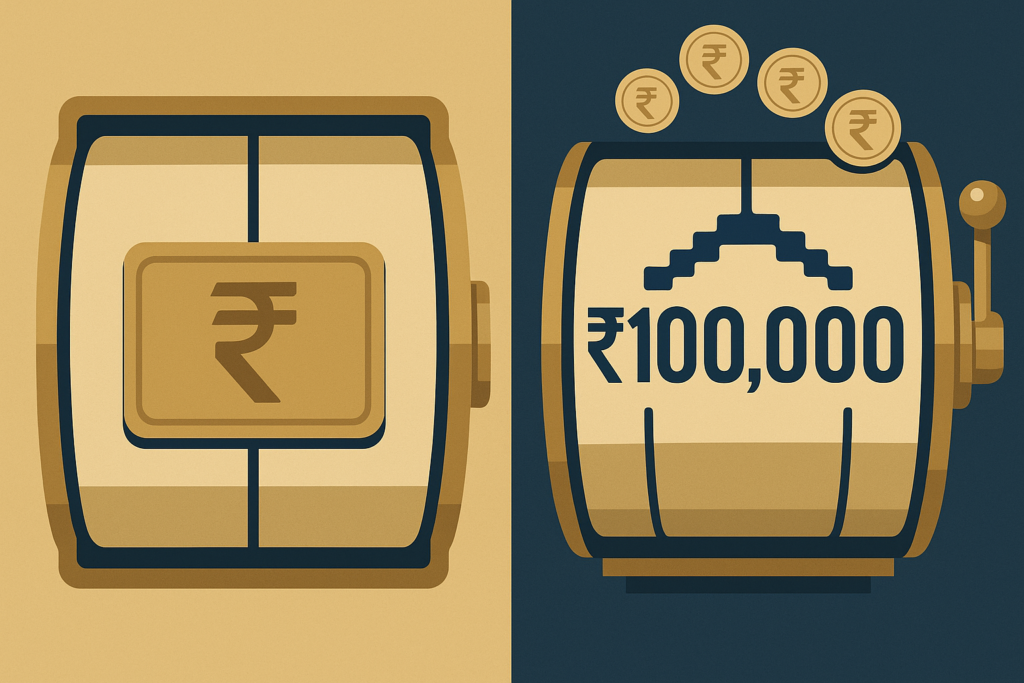
The difference between fixed vs progressive jackpots comes down to one thing: whether the prize is a set number or a pot that keeps growing. A fixed jackpot pays a predetermined amount, say ₹1 lakh, no matter when you win it. A progressive jackpot grows with every qualifying bet placed on the game until someone hits it, which is how a single slot ends up paying out crores.
That growth isn’t free. The bigger the pot, the longer the odds, and jackpot slots usually give back less in normal play than a standard slot does. Here’s how both types actually work, where the money comes from, and what realistic expectations look like.
What are fixed jackpots?
A fixed jackpot is a top prize with a value set by the game’s paytable that never changes, usually expressed as a multiple of your stake.
Say a slot lists its top prize as 5,000× your bet. Stake ₹20 and the jackpot is ₹1,00,000. Stake ₹10 and it’s ₹50,000. The number moves with your bet size, but it doesn’t creep upward over time and it doesn’t reset after someone wins. Some casinos also run fixed-amount jackpots on table games and bingo rooms, where the prize is simply advertised as a flat figure.
The trade-off is straightforward. Fixed jackpots are far more reachable than progressives because the prize is smaller, so the game’s maths can afford to hand it out more often. You’ll also usually find that a fixed-jackpot slot keeps a normal RTP and payout percentage in the typical 94–97% band, because no slice of your bet is being siphoned into a separate pool.
Progressive jackpot meaning
A progressive jackpot is a prize pool that increases every time a player places a qualifying bet on the linked game, then resets to a seed amount once it’s won.
You’ve seen the ticking counter at the top of the screen. That number is real money already contributed by players, held by the game provider or casino until someone triggers the win condition. Progressives can reach several crores on the biggest networked games, and that’s precisely why they’re so hard to win. The pot only gets that large because thousands of players spent months not winning it.
How progressive jackpots grow
A small percentage of each qualifying bet, commonly around 1%, is diverted from the normal prize pool into the jackpot pool. On a ₹100 spin, roughly ₹1 goes to the counter.
Two details matter here. First, the jackpot pool usually splits: part of it feeds the visible jackpot, and part is held back to seed the next one so the counter never starts at zero. Second, that contribution is still counted inside the game’s advertised RTP. If a slot publishes 96% RTP with a 2% jackpot contribution, then the base game is only returning about 94% to the vast majority of players who never hit the top prize. The other 2% exists, but it goes to one person, eventually.
Many progressives also require a qualifying or maximum bet to be eligible. Play below that level and the jackpot symbol combination may pay nothing, or a reduced amount. Always read the game info panel before you assume you’re in the running.
Types: standalone vs networked
- Standalone progressive — the pool is fed only by bets on that single game at that single casino. Pots are modest by progressive standards, often tens of thousands to a few lakh rupees, and they’re won relatively often.
- Local or in-house progressive — linked across several games or all players at one operator or one software brand. Mid-sized pots, mid-length odds.
- Networked (wide area) progressive — linked across many casinos that all license the same game. Pots reach crores, wins are rare.
Key differences: fixed vs progressive jackpots
The table compares the two on the four things that actually affect your session: prize size, odds, how often anyone wins, and what it does to the game’s payout percentage.
| Factor | Fixed jackpot | Progressive jackpot |
|---|---|---|
| Prize amount | Set by paytable, e.g. 5,000× stake (₹50,000 on a ₹10 bet) | Grows continuously; standalone pots in lakhs, networked pots can pass ₹1 crore |
| Odds of winning | Long, but realistic — often in the tens or hundreds of thousands of spins | Very long; the largest networked jackpots are commonly quoted in the tens of millions to one per qualifying spin |
| Frequency of wins | Hit regularly across the player base | Standalone: weeks or months. Networked: sometimes once or twice a year |
| Effect on payout percentage | Full RTP is paid through normal play | Part of RTP is locked in the jackpot, so base-game returns are lower for everyone who doesn’t win it |
| Bet requirements | Usually none beyond normal stakes | Often a minimum or max-bet qualification |
| Session feel | Steadier, lower slot variance | Swingy; long dry runs are the norm |
How jackpot odds actually work
Every spin is an independent event produced by a random number generator. There is no build-up, no “due” jackpot, and no pattern in the counter that tells you a hit is coming. A pot at ₹4 crore is no more likely to drop on your next spin than it was at ₹40 lakh.
Jackpot odds are baked into the game’s design, usually as a fixed chance per qualifying spin or via a separate random trigger. Studios sometimes publish these figures in the game rules, and where they do, the numbers for big networked prizes land in the millions-to-one range. Put it in perspective: at one in 20 million per spin, playing 500 spins a day every day would still leave you, on average, well over a hundred years from an expected hit. That is the honest shape of it.
The second honest point concerns progressive jackpot games and the house edge. Because a slice of every bet goes into a pool most players will never touch, the money coming back to you during ordinary play is lower than the headline RTP suggests. A plain slot at 96% RTP has a 4% house edge and pays that 96% out through regular wins. A progressive at a nominal 96% might only be returning 93–94% through the base game. You’re effectively buying a lottery ticket with part of every spin.
What is a networked jackpot?
A networked jackpot, also called a wide-area progressive, is a single prize pool fed by players across many different casinos that all run the same game from the same provider.
Microgaming’s Mega Moolah is the classic example of this model, and most major studios run something similar. Instead of one operator’s players building the pot, thousands of players across dozens of sites contribute at once. That’s why networked pots climb so fast and reach headline-grabbing sizes.
The cost is at both ends. Odds are the longest of any jackpot type, and the game’s base-game return is typically the thinnest, because a bigger share of every bet has to be routed to the pool to keep it growing. Networked jackpots are also where the multi-tier structure shows up: a game might have mini, minor, major and mega levels, with the smaller tiers hitting often enough to keep things interesting while the mega tier stays out of reach for long stretches.
Which type should you choose?
Choose based on the kind of session you want, not on which one you think you can win, because neither is beatable over time. Both carry a house edge by design.
- Pick fixed jackpots if you want your bankroll to last, prefer more frequent smaller wins, and want the full advertised payout percentage working in normal play. Better for low-stakes, longer sessions.
- Pick standalone or local progressives if you want a meaningful top prize without the absurd odds of a crore-level pot. A middle ground.
- Pick networked progressives only if you’re genuinely fine with the entertainment being the chase itself. Treat a spin as the cost of watching the counter, budget accordingly, and expect nothing.
Two practical habits help regardless of type. Check the game info screen for the RTP, the jackpot trigger rules and any qualifying bet, since these vary between the same game at different casinos. And decide your spend before you open the game, not after a long losing run, when high slot variance makes chasing feel reasonable.
Jackpots are entertainment, not income, and no jackpot type is a strategy. Set deposit and loss limits, use session reminders, and if it stops being fun, use the cool-off or self-exclusion tools your casino provides. See our responsible gambling guide for the tools and support options available.
FAQ
What is the difference between fixed and progressive jackpots?
A fixed jackpot pays a predetermined amount set by the paytable, usually a multiple of your stake. A progressive jackpot grows from a percentage of every qualifying bet and resets once won, so it can be far larger but is much harder to hit.
How does a progressive jackpot grow?
Roughly 1% of each qualifying bet, depending on the game, is diverted into the prize pool. Part funds the visible counter and part seeds the next jackpot, so the counter restarts at a base amount after a win rather than at zero.
Are jackpot odds worse than regular slots?
Yes, for the top prize, and base-game returns are usually lower too. Since part of every bet goes into the jackpot pool, a progressive slot pays back less through ordinary wins than a comparable non-jackpot slot with the same headline RTP.
What is a networked jackpot?
A jackpot pool shared by players across multiple casinos running the same licensed game. Mega Moolah-style games work this way. Pots grow very large because thousands of players feed them simultaneously, which also makes the odds of any single player winning extremely long.