

The real starting line isn’t Las Vegas
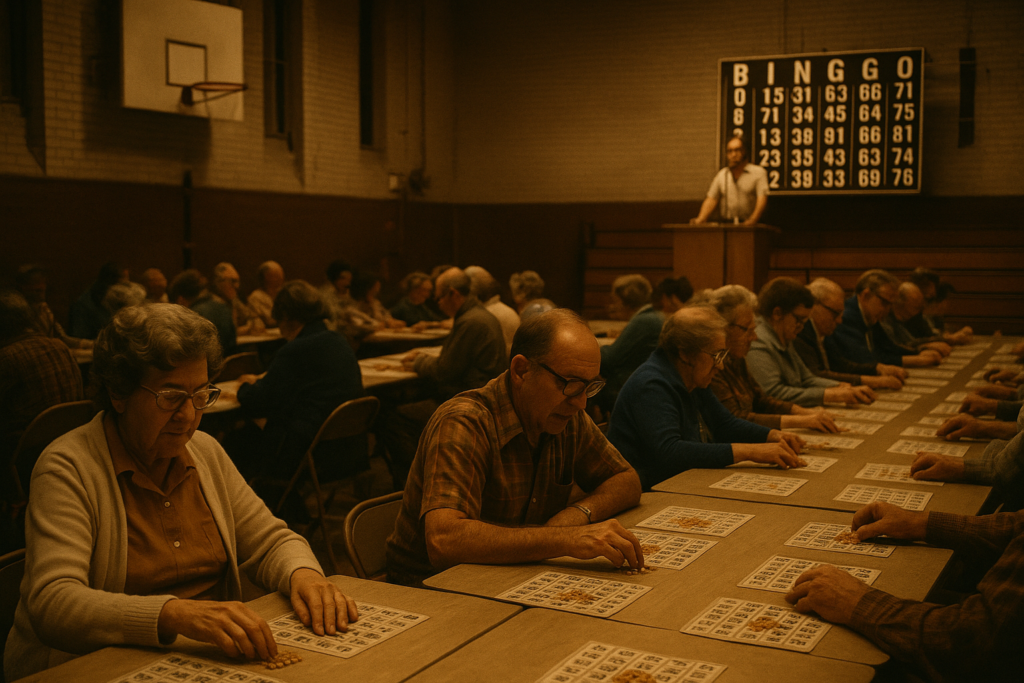
Most people assume the modern history of casino gaming runs through the Nevada desert: neon, Rat Pack, corporate megaresorts. For one of the largest pieces of the American industry, that’s wrong. Tribal gaming in the United States, reported at more than $46 billion in 2025, traces back to a gymnasium in a two-county stretch west of Green Bay, Wisconsin, where two women, Sandra Brehmer and Alma Webster, started a bingo game in 1976. Single paper cards. Kernels of corn and chips to cover the spaces. Fewer than 50 players on some nights.
That’s the whole lesson of gaming history compressed into one image. Regulated casino industries almost never begin as casino industries. They begin as a casual game somebody runs in a hall, a church basement, a fire station, a website, and they become regulated only after they get big enough to be worth fighting over.
Victor Rocha, conference chairman at the Indian Gaming Association, put it plainly in CDC Gaming’s account of the era: “When you open these little bingo halls and you’re getting money … it brings the tribes closer to the American dream. Bingo was that first crack in the door that day.”
A gym floor, electronic boards, and a $100 jackpot
The Oneida game grew the way grassroots gambling always grows: by word of mouth, then by infrastructure. Attendance doubled from those first tiny sessions. Tables and chairs filled the gymnasium floor. A sound system went in, then electronic boards on the walls. Jackpots climbed to $100, a number worth sitting with, because the operation that eventually became Oneida Casino Hotel started with prizes smaller than a modern slot bonus buy.
Taryn E. Webster, now CEO of Oneida Casino Hotel, and assistant general manager Jessalyn Harvath described that arc in written answers to CDC Gaming, along with the part that rarely makes the brochure version of gaming history: “The local jurisdictions opposed and threatened to shut us down, but we persisted and battled in the courts and eventually won.”
Bingo spread across the country for an unglamorous reason. Tribes needed revenue for basic services and had few other tools. The Seminole Tribe of Florida opened its bingo operation in 1979, and Chairman Marcellus B. Osceola Jr. framed the motive the same way: “Health care, education, housing, senior services, and other needs were on the list and it was our hope that bingo games could help to fund them.”
The origins of bingo, and why churches got there first
Bingo arrived in these gymnasiums already carrying a strange legal status. The game’s ancestry is usually traced to Italian lottery games, then to a travelling carnival game called beano that reached the United States in the early twentieth century, then to the commercial card sets sold under the name bingo from the late 1920s onward. Nothing about it was designed as casino gambling. It was a parlour game with a prize.
That perception is exactly why bingo became the wedge. By the 1970s American states had spent decades carving out charitable exemptions so that Catholic parishes, volunteer fire companies and veterans’ clubs could run bingo nights legally. Gambling was banned; bingo for good causes was fine. Once a legal system says a game is acceptable when a church runs it, it has a very hard time explaining why the same game is criminal when a sovereign tribal government runs it to fund a health clinic. Charitable bingo built the argument before anyone needed to make it.
How gambling regulation started: in courtrooms, not committee rooms
The instinct to assume Congress designed tribal gaming gets the sequence backwards. The games came first, the lawsuits came second, and the federal framework came more than a decade later.
Wisconsin tried to stop Oneida bingo and lost. Oneida Indians of Wisconsin v. State of Wisconsin in 1981 was the turning point, and the decision leaned on sovereignty as an interpretive frame rather than a trump card: “the Indian sovereignty doctrine is relevant, then, not because it provides a definitive resolution of the issues in this suit, but because it provides a backdrop against which the applicable treaties and federal statutes must be read.”
Florida ran the same play against the Seminoles and also lost. Seminole Tribe v. Butterworth, named for Broward County sheriff Robert Butterworth, turned on whether the state could shut down or cap tribal bingo. The state’s arguments will sound familiar to anyone who has read a modern licensing consultation: fear of organised crime infiltrating the games, and the regulatory gap created if the state were excluded from oversight entirely. Underneath it sat Public Law 280, the 1953 statute that handed certain states criminal jurisdiction over Indian country, which raised the question that decided a decade of litigation. Was a state gambling law criminal-prohibitory, or merely civil-regulatory?
The Supreme Court answered in 1987 in California v. Cabazon Band of Mission Indians: where a state permits a form of gambling under regulation rather than banning it outright, it cannot impose that regulatory scheme on tribal land. California ran a lottery and licensed charitable bingo, so its objection collapsed. Congress responded the following year with the Indian Gaming Regulatory Act of 1988, which built the three-class structure the industry still runs on and created the National Indian Gaming Commission as federal regulator.
| IGRA class | What it covers | Who regulates it |
|---|---|---|
| Class I | Traditional and social games tied to tribal ceremonies, minimal prizes | Tribal government alone |
| Class II | Bingo and games similar to bingo, pull-tabs, certain non-banked card games | Tribe, with federal oversight from the National Indian Gaming Commission |
| Class III | Everything else: slot machines, banked card games, roulette, craps, sports betting | Requires a negotiated tribal-state compact plus tribal and federal oversight |
Read that table as history rather than a compliance chart and it’s remarkable. Bingo, the corn-kernel game, got its own protected category in federal law because that was the game tribes were already running and winning court cases over. The law was drafted around the facts on the ground.
The evolution of casino games ran straight through the bingo card
Here’s the part that surprises people who only know modern slot floors. Because Class II gaming needs no state compact and Class III does, the mechanical distinction between bingo and slots became commercially enormous. That pressure produced electronic bingo systems: terminals with spinning-reel graphics and familiar slot presentation, where the outcome is actually determined by a networked bingo draw among players rather than by an independent per-spin result.
Players see reels. The math underneath is a bingo game. Whole product categories, cabinet designs and supplier businesses exist because of a legal boundary drawn in 1988 around a church-hall pastime. If you want a single example of regulation shaping game design rather than the reverse, that’s it.
What this arc is worth to anyone working in iGaming now
The bingo-to-casino story is not nostalgia. It’s a pattern, and it repeats with uncomfortable reliability.
- Regulators react to scale, not to activity. Nobody legislated against a 50-player bingo night. The lawsuits arrived once the gym floor was full and the jackpots were real. Online verticals get the same treatment: ignored while niche, contested once the revenue shows up in someone else’s numbers.
- Definitions carry more value than marketing. Oneida and the Seminoles won on jurisdiction and on the prohibitory-versus-regulatory distinction, not on public sympathy. In the current market the same fights are about whether a product is a lottery, a game of skill, a sweepstakes, a derivative or a casino game. The classification decides the licence, the tax and sometimes the existence of the business.
- A carve-out for one operator is a precedent for everyone. Charitable bingo exemptions were never meant to open a multi-billion-dollar industry. They did, because inconsistency is the weakest position a regulator can hold.
- Purpose-built frameworks beat prosecution. Florida and Wisconsin both tried to shut games down and both ended up with negotiated compacts instead. Twelve years of litigation produced IGRA. Jurisdictions still learn this the slow way.
- The revenue argument is the durable one. Tribes justified bingo by naming the clinics, schools and housing it funded. Modern licensing debates run on the same fuel: tax receipts, sports funding, consumer protection. Whoever tells that story credibly tends to get the framework they want.
None of this changes the arithmetic of the games themselves. A bingo card in 1976 and an electronic Class II cabinet today both keep a margin for the operator, exactly as every slot and table game does through its house edge. The industry grew from that margin, and honest history says so. If your own play stops feeling like entertainment, use the deposit and session limits, cool-off periods and self-exclusion tools that licensed operators are required to provide.
The Oneida gymnasium has been gone for decades and the $100 jackpot looks quaint against a $46 billion sector. But the next regulated vertical, whatever it turns out to be, is almost certainly running right now in some lightly supervised corner, drawing a crowd, and waiting for someone to sue it.