

What happened
Injuries impact betting odds because odds are just a market’s best guess at win probability, and nothing rewrites that guess faster than losing a starting quarterback. The Minnesota Vikings gave the sportsbook world a clean example of it in September 2026, and the details are worth walking through slowly.
Minnesota opened the 2026 season with an improbable 39-22 win over the Green Bay Packers, coming back from a slow offensive start after quarterback Kyler Murray went down with an early injury. The win looked great on the scoreboard. The quarterback question it left behind was the real story heading into Week 2 against the Chicago Bears on September 20, with Murray’s availability unresolved and Carson Wentz in line to start if he couldn’t go.
Former Vikings linebacker Chad Greenway, who spent all 10 of his NFL seasons in Minnesota and made a Pro Bowl there, talked through the situation in an interview published by Casino.org on September 17, 2026, tied to Audacy’s show Inside The North. His read on the backup was measured rather than alarmed: Wentz, he said, has done a nice job in a secondary role. Greenway also suggested JJ McCarthy could become a trade option at some point, and pointed to containing Caleb Williams’ movement and running as the deciding factor against the Bears.
That’s the raw material. A starting quarterback with an unclear status, a capable but different backup, a mobile opposing quarterback, and three days of practice reports before kickoff. For anyone learning how betting markets work, it’s close to a textbook case.
Why it matters
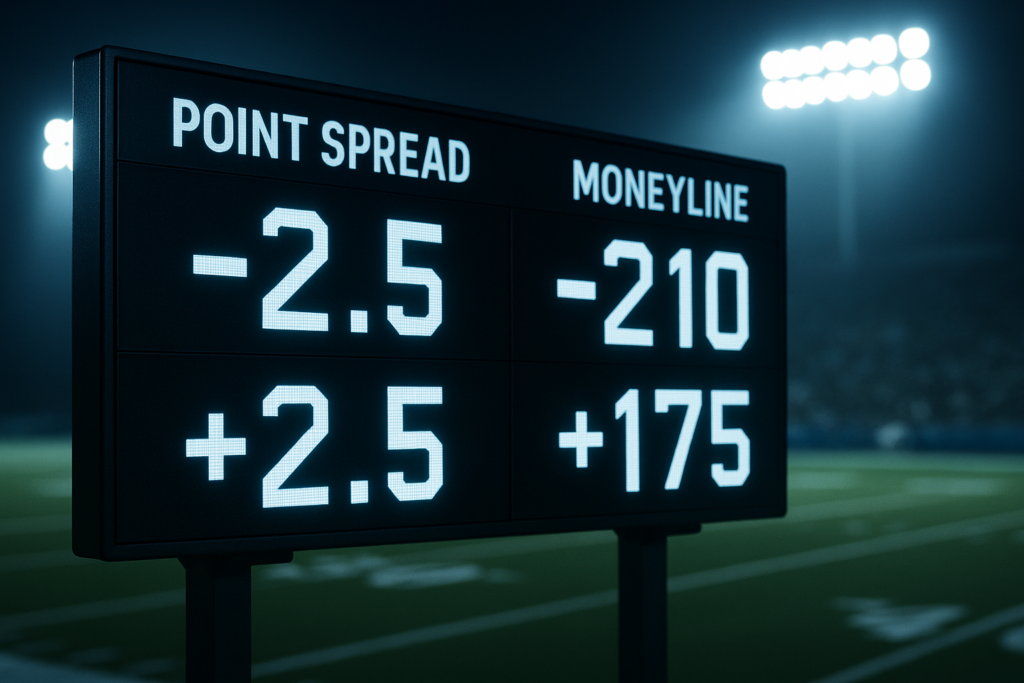
Quarterback is the only position in American football where one absence can shift a game’s entire probability structure. Betting analysts have long treated an elite starter as worth roughly three to seven points on a point spread compared with his backup, depending on how big the gap between the two players is. That’s a rule of thumb, not a law, but it explains why a single injury report line can do more to a price than a week of team news.
The mechanics are straightforward once you separate the odds from the underlying probability. Decimal odds of 1.60 imply a 62.5% chance (1 ÷ 1.60). If the starting quarterback is ruled out and that same team drifts to 1.90, the implied probability drops to about 52.6%. Nothing about the team changed physically in those few hours. The market’s estimate changed, and the price followed. Both of those numbers, by the way, also include the bookmaker’s margin, so implied probabilities across a two-way market always add up to more than 100%. At 1.90 on each side you get 52.6% + 52.6% = 105.3%, an overround of a little over 5%. That margin is exactly why the house profits over time regardless of who is starting at quarterback.
How odds change when injury news breaks
The sequence is usually the same across sports and sportsbooks:
- News lands. A report, a practice update, or an official designation hits.
- Markets get suspended. Many books pull the affected game and its player props within seconds, rather than let stale prices sit there.
- Prices are re-set. Traders rebuild the spread, moneyline and total around the new starter, then reopen.
- The market settles. Money flowing in on either side nudges the number until it stops moving much.
By the time a casual bettor reads the headline, steps one through three have usually finished. That is the part most people underestimate: the “value” created by injury news is typically gone before the news is widely known, because professional bettors and the books themselves watch the same feeds around the clock.
Different markets react in different ways, which is where the learning really is:
| Market | Typical reaction to a starting QB being ruled out | Why |
|---|---|---|
| Point spread | Moves against that team, often by a few points | Backup is usually a downgrade in expected scoring |
| Moneyline | Price lengthens; implied win probability falls | Direct re-pricing of win chance |
| Game total (over/under) | Often drifts down, but not always | Conservative play-calling can cut points, or a weak offence can mean more possessions for the opponent |
| Player props | Frequently removed entirely, then reissued | Passing, rushing and receiving lines all depend on who’s throwing |
| Season futures | Small adjustment for a one-week absence, larger for long-term injuries | One game is a fraction of a 17-game season |
The other thing the Vikings case illustrates is uncertainty itself. “Questionable” is not information you can price cleanly. NFL teams file practice participation reports and assign designations before game day, and the final word arrives on the inactive list released 90 minutes before kickoff. Between those two points, the market is guessing at a guess.
| Designation | What it signals |
|---|---|
| Out | Will not play — markets re-price fully |
| Doubtful | Unlikely to play — markets price mostly for the backup |
| Questionable | Genuinely uncertain — prices sit between the two scenarios |
And the matchup context matters as much as the injury. Greenway’s point about Caleb Williams’ mobility is the sort of thing that already sits inside a spread. Markets price opponents, weather, rest and travel alongside personnel. A single injury never exists in isolation.
What it means for readers in India
NFL betting has a growing following in India, and the practical issues here are less about football knowledge than about timing, access and rules.
The clock works against you. Most Sunday afternoon NFL games kick off at 1:00 pm Eastern, which is 10:30 pm IST, so the all-important inactive list drops around 9:00 pm IST. Sunday Night Football lands near 5:50 am IST on Monday. Late-breaking injury news therefore breaks in the Indian night, often after most recreational bettors have stopped watching. If you’re betting a game whose starter is “questionable”, you are either awake for the confirmation or you are accepting real uncertainty in your price.
Legality is not uniform. Online betting in India is governed by a patchwork of central and state-level law, and several states restrict or prohibit it outright. Check what applies where you live before you do anything else, and treat that as non-negotiable rather than a technicality.
Winnings are taxable. Income from online gaming in India is taxable, with tax deducted at source on net winnings. Rates and rules have changed in recent years, so confirm the current position with a qualified tax professional rather than relying on a forum post.
Margins matter more than opinions. Indian readers often compare sportsbooks on bonus size. The more useful comparison is the overround on the markets you actually bet. A book pricing a two-way market at 1.95/1.95 keeps around 2.6% margin; one at 1.83/1.83 keeps closer to 9%. Over a season, that difference dwarfs any injury read you might have.
Practical account housekeeping. Finish KYC before you plan to withdraw, not after. Know your deposit method’s limits and payout timelines, especially if you’re using UPI, because the moment you actually want your money is rarely the moment you want to be uploading documents.
One honest caveat: none of this is a system. Understanding how injuries impact betting odds makes you a better-informed reader of a market; it doesn’t hand you an edge over one that has already absorbed the same news. Sportsbooks build a margin into every price, and that margin is what makes them profitable over time.
Key takeaways
- Odds are priced probabilities. Convert decimal odds with 1 ÷ odds to see what the market actually believes.
- Quarterback injuries are the biggest single-player movers in NFL markets, commonly discussed as worth roughly three to seven points of spread depending on the backup.
- Books suspend markets and pull player props on breaking injury news, then reopen at a re-set number. Prices usually adjust before the story is widely read.
- “Questionable” means the price contains uncertainty, not information. The NFL inactive list, out 90 minutes before kickoff, is the real confirmation.
- Totals don’t always fall when a starter sits — game script and pace cut both ways.
- For Indian readers, the key practical factors are state-level legality, kickoff times deep in the IST night, tax on net winnings, and the bookmaker’s margin on the markets you use.
- Set deposit and loss limits before you bet, use cool-off or self-exclusion tools if betting stops being entertainment, and never bet money you need. Support services for problem gambling are available and worth contacting early rather than late.
Source for the Vikings details: an interview with Chad Greenway published by Casino.org on September 17, 2026, produced in connection with Audacy’s Inside The North.