

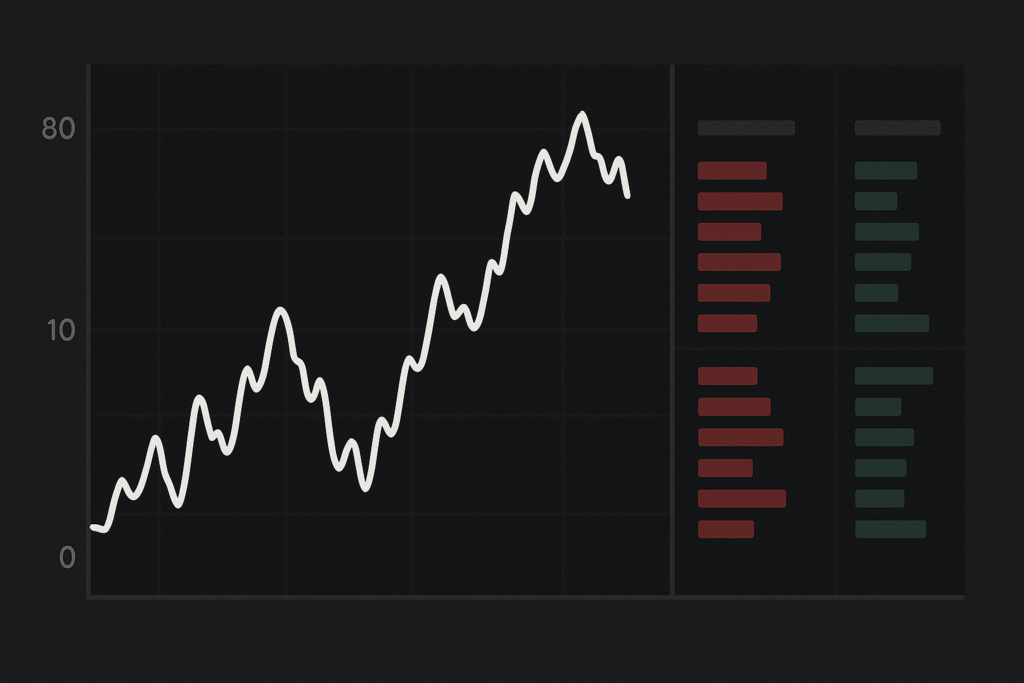
A prediction market is a platform where people buy and sell shares in whether a specific event will happen. That definition is accurate, and it’s also a little misleading — because the number on the screen isn’t a payout, it’s a probability, and the person on the other side of your trade isn’t a bookmaker taking a position against you. Both of those details change how the thing behaves.
Here’s prediction markets explained from the mechanics up: what the contracts are, how prices get set, where they genuinely differ from a betting exchange, and where Indian readers stand legally. This is an explainer, not a recommendation to trade anything.
What are prediction markets?
Prediction markets are trading venues for contracts tied to the outcome of a real world event. Each contract has a binary resolution: yes or no, happened or didn’t. Platforms such as Polymarket and Kalshi have made the format familiar in the United States, where contracts are typically priced between 1 and 99 cents and cover outcomes including races for mayor, governor and the US Senate.
The price is the market’s collective estimate of probability. If a “yes” share trades at 63 cents, traders are collectively pricing that outcome at roughly 63%. Buy it, and you either receive the full settlement value (100 cents, or ₹100 in a rupee illustration) if the event happens, or nothing if it doesn’t.
Two things follow from that structure. First, you are always buying at a stated probability rather than at odds. Second, because contracts trade continuously, you can usually sell before the event resolves — which makes the activity look more like trading and less like placing a wager. That resemblance is exactly what the legal arguments in the US are about.
How prediction markets work, step by step
Strip away the interface and the process is short:
- A question is written with a verifiable resolution. “Will X be confirmed by 31 December?” needs an unambiguous source of truth and a deadline, or the market can’t settle cleanly.
- The contract splits into two sides. Yes and No. Their prices sum to roughly 100, because exactly one side will be worth 100 at the end.
- You buy shares at the current price. Your maximum loss is what you paid; your maximum return per share is 100 minus what you paid.
- The price moves as others trade. New information, new orders, new price. This continuous re-pricing is what economists call price discovery.
- The market settles, or you exit early. At resolution, the winning side pays 100 and the losing side pays 0. Before that, you can sell your shares at whatever the market will pay.
Share pricing and probability
The arithmetic is simple and worth doing once by hand. Suppose a Yes share costs ₹40 in our illustration, with a ₹100 settlement value:
- Implied probability: 40%.
- If the event happens: you receive ₹100, a profit of ₹60 per share.
- If it doesn’t: you receive nothing, a loss of ₹40 per share.
- Break-even: the event must happen more than 40% of the time for that price to be worth paying, before fees.
Notice that a “cheap” share is cheap because the market thinks the outcome is unlikely. Low price and good value are not the same thing. And fees matter: platforms charge trading or settlement fees, which pushes your real break-even slightly above the quoted probability. As with any wagering or speculative product, costs plus the spread mean the average participant does not come out ahead over time.
Market making and liquidity
Prices come from an order book: a list of buy orders (bids) and sell orders (asks) at different price levels. A limit order sits in the book until someone matches it. A market order takes the best available price immediately.
Market makers are participants who quote both sides at once — willing to buy at 38 and sell at 41, for example — and earn the spread for providing that service. Their presence is what liquidity actually means in practice: you can get in and out near the displayed price without moving it much.
Thin markets behave differently. On an obscure contract with a wide spread, a modest order can shift the price several points, which is why a single large trade in a quiet market can make headlines it doesn’t deserve. Liquidity, not opinion, is often the story behind a sudden move.
Betting exchange vs prediction market: what actually differs
Both are peer-to-peer. Both let you exit early. The differences are in the pricing language, the fee model and what gets listed.
| Feature | Betting exchange | Prediction market |
|---|---|---|
| Price format | Decimal odds (e.g. 2.50) | Share price as probability (e.g. 40 of 100) |
| How you take a side | Back or lay an outcome | Buy Yes or buy No shares |
| Your role | Bettor matched against another bettor | Trader holding a contract position |
| Downside exposure | Stake when backing; liability can exceed stake when laying | Capped at the price paid per share |
| Typical fee model | Commission on net winnings per market | Trading and/or settlement fees on the contract |
| Early exit | Place an offsetting bet at current odds | Sell the shares in the order book |
| Typical markets | Sport, racing, some novelty markets | Politics, economics, policy, sport, company and cultural events |
Pricing models
An exchange quotes what you get back; a prediction market quotes what the outcome is worth now. Decimal odds of 2.50 and a 40-of-100 share price describe the same 40% probability. The prediction market just states it directly, which removes a conversion step and makes mispricing easier to spot at a glance.
User experience
Exchange users think in stake and liability. Prediction market users think in position size and average entry price. The latter framing borrows deliberately from equities, and it changes behaviour: people scale in, scale out, and treat an open position as something to manage rather than a ticket to hold until the whistle.
Market structure
Sports exchanges concentrate enormous volume into short, frequent events. Prediction markets often run for months on a single question, with volume arriving in bursts around news. That means longer periods of low liquidity, wider spreads and prices that can drift on very little trading.
Odds vs probability: converting between the two
Implied probability is 1 divided by the decimal odds. Multiply by 100 and you have the equivalent share price.
| Decimal odds | Implied probability | Equivalent share price (of 100) |
|---|---|---|
| 1.25 | 80% | 80 |
| 1.50 | 66.7% | 67 |
| 2.00 | 50% | 50 |
| 2.50 | 40% | 40 |
| 5.00 | 20% | 20 |
| 10.00 | 10% | 10 |
One more piece of honesty about pricing. With a traditional bookmaker, the implied probabilities across a market add up to more than 100% — two outcomes at 1.90 each imply 52.6% + 52.6% = 105.3%. That extra 5.3% is the overround, the built-in margin. On a peer-to-peer venue the two sides sum much closer to 100, with the cost showing up as commission or fees plus the bid-ask spread instead. Cheaper is not free.
Why event trading is suddenly everywhere
The immediate driver is American politics. Election-season trading volumes have climbed sharply, and prediction market prices are now quoted in mainstream coverage alongside polls. That has pulled in regulators and election officials: several states have moved to treat the platforms as unlicensed casinos, and administrators have voiced unease. “This is a troubling trend that election administrators across the nation must deal with,” said Jared DeMarinis of the Maryland State Board of Elections, reflecting concern that financial incentives could affect public confidence in results.
The platforms argue the opposite case: that trading a contract on an outcome is close to what investors already do when they position portfolios ahead of an election. Columbia Law School professor Joshua Mitts has noted that “one can make the argument that the entire stock market, at some level, is affected by elections and outcomes.” Kalshi and Polymarket also point to insider trading protections required under federal law — Kalshi disclosed on 31 August that it suspended and fined North Carolina congressional candidate Laurie Buckhout for three years for trading on her own race.
On accuracy, Kalshi says its research shows strong calibration: outcomes priced at 60% happen close to 60% of the time. Calibration is not clairvoyance. The same markets heavily favoured a losing candidate in a primary for Wisconsin governor, a race where polling also missed badly, and prices swung awkwardly during the Los Angeles mayoral primary count. Treat a market price as a live estimate carrying real uncertainty, not a forecast.
Where India stands
India has no dedicated framework for prediction markets. Real money online gaming sits under a mix of central rules and state legislation, layered on top of older statutes including the Public Gambling Act of 1867, with courts historically distinguishing games of skill from games of chance. Prediction contracts don’t map neatly onto either category, and nothing here should be read as a legal opinion.
Practically, most international prediction markets restrict users in India through their own terms of service and geographic blocks, so the realistic value of understanding them is analytical: reading probability prices, interpreting them in news coverage, and recognising when a quoted number rests on thin liquidity. Separately, note that winnings from online gaming are taxable in India, with TDS applying on net winnings — check current rates with a qualified professional rather than a forum post.
If you do engage with any real money wagering product where it is legal for you to do so, you must be of legal age, use deposit and loss limits, and treat the money as spending rather than income. Every venue of this kind carries a cost, whether it’s called commission, spread or house edge. Support services for problem gambling are available if play stops feeling like play.
FAQ
What are prediction markets in simple terms?
Platforms where you buy and sell contracts on whether an event will happen. Each contract settles at full value if the outcome occurs and nothing if it doesn’t, so the trading price reads as a probability percentage.
How do prediction markets work?
A binary question is listed with a fixed resolution date and source. Traders buy Yes or No shares through an order book, prices move as orders arrive, and holders can sell before resolution or wait for settlement at 0 or 100.
What’s the difference between prediction markets and betting exchanges?
Mainly presentation and structure. Exchanges quote decimal odds and use back/lay with commission on net winnings; prediction markets quote probability directly, cap per-share downside at the purchase price, charge trading or settlement fees, and list a far wider range of non-sporting events.