

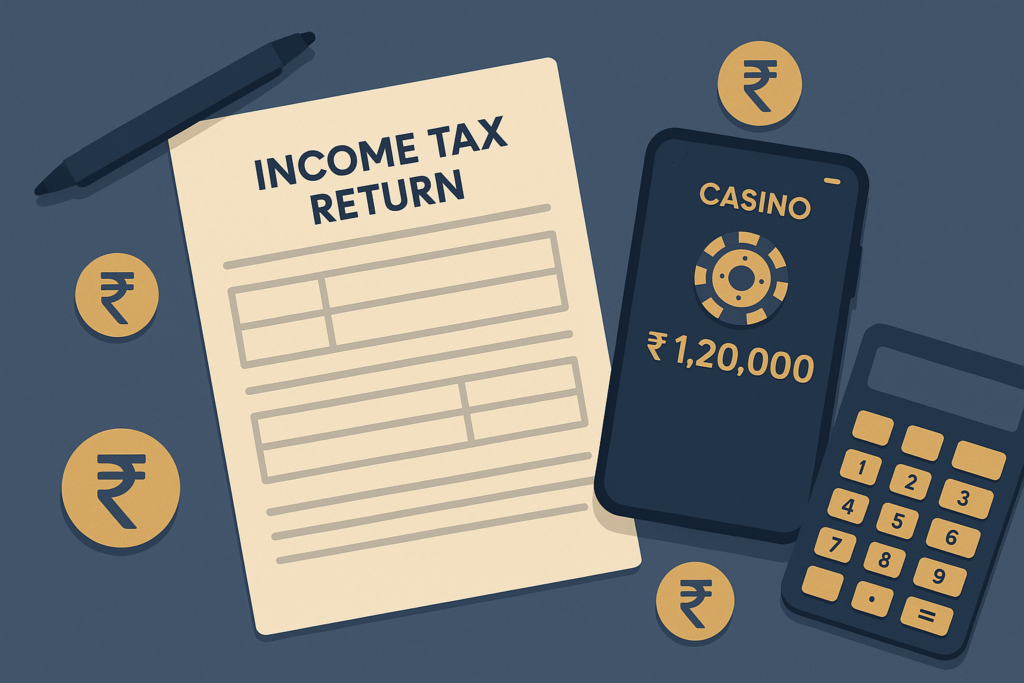
The short answer: the tax on online casino winnings in India is a flat 30%, and the operator is normally required to deduct it before your money reaches your bank account. There is no basic exemption limit for this income, no deduction for expenses, and no way to set off your losing sessions against your winning ones. On top of the 30% you may also owe surcharge (if your total income crosses the prescribed thresholds) and the 4% health and education cess when your final liability is computed in your return.
That is the whole framework in two sentences. The details, which is where most players get tripped up, are about how the deduction is calculated, when it happens, and what you still have to declare yourself.
How online gambling winnings are taxed in India
Gambling and gaming winnings are treated as “income from other sources” and taxed at a special flat rate rather than at your normal slab rate. It does not matter whether you earn ₹3 lakh a year or ₹30 lakh — the winnings themselves are taxed at 30%. And unlike salary or business income, you cannot reduce the taxable amount by claiming entry fees, subscriptions, data costs, or losses.
Current tax rates on gaming winnings
Two different provisions apply depending on what kind of win it is. Section 115BBJ covers net winnings from online games. Section 115BB is the older provision covering lotteries, crossword puzzles, card games, betting and gambling generally.
| Type of winnings | Charging section | Tax rate | TDS section | TDS threshold |
|---|---|---|---|---|
| Net winnings from online games (casino apps, online card and crash games, fantasy sports) | 115BBJ | 30% flat | 194BA | No threshold |
| Lottery, crossword puzzles, card games, betting and gambling (offline or otherwise not covered as “online game”) | 115BB | 30% flat | 194B | Aggregate above ₹10,000 in a financial year |
| Winnings from horse races | 115BB | 30% flat | 194BB | Aggregate above ₹10,000 in a financial year |
Note the distinction between the tax rate and the TDS rate. TDS on payments to residents is deducted at 30% without surcharge or cess. Surcharge and the 4% cess get added when you compute your actual liability in the return, so a large win can leave a small balance still payable even after TDS.
Legal framework: Income Tax Act provisions
Section 115BBJ and Section 194BA were introduced by the Finance Act 2023 specifically because the old ₹10,000-per-transaction logic did not work for online gaming wallets, where players deposit, win, lose and withdraw dozens of times a month. Section 194BA applies from 1 July 2023 and works on net winnings computed across your whole account, not on individual wins.
Section 58(4) is the provision that blocks deductions: no expenditure or allowance can be claimed against winnings of this type. Rule 133 of the Income-tax Rules sets out the arithmetic for net winnings, and the CBDT has issued guidelines explaining how operators should apply it.
One point worth stating plainly: taxability is separate from legality. Income tax applies to the winnings regardless of the state gaming laws that govern whether a particular game or operator is permitted where you live. Real-money gaming in India also attracts 28% GST on deposits for online money gaming — that is an operator-side liability, but it affects the value you get for each rupee deposited.
TDS (tax deducted at source) on casino and betting winnings
Yes, TDS is deducted on casino winnings when the operator is within the Indian tax net. The operator is the “deductor” and is legally responsible for withholding 30% and depositing it against your PAN.
When TDS is deducted
Under Section 194BA there are two trigger points:
- At withdrawal. Every time you take money out of your gaming account, tax is deducted on the net winnings included in that withdrawal.
- At the end of the financial year. Whatever net winnings are still sitting in your account balance on 31 March are taxed then, even if you never withdrew them.
Net winnings are worked out on the account as a whole. For the first withdrawal in a financial year, the calculation is essentially: amount withdrawn, minus your own non-taxable deposits made up to that point, minus the opening balance of the account. Later withdrawals subtract the net winnings already taxed earlier in the year, and the year-end computation adds the closing balance into the equation. The practical effect is that you are taxed on the real gain in your wallet, not on each winning round.
“Non-taxable deposit” means money you put in from your own already-taxed funds. Bonus credits, cashback and promotional balances added by the operator are not your deposits, so they do not reduce net winnings. If you want to understand how deposits and withdrawals actually move, our guide to casino payment methods for Indian players covers UPI and bank transfer mechanics.
TDS rates and thresholds
The rate is 30%. For online games there is no ₹10,000 threshold at all — the concession that exists is narrow: under CBDT guidelines an operator may skip deduction where net winnings in a withdrawal do not exceed ₹100 in a month, on the condition that the tax is deducted later (at the next larger withdrawal or at year end). It is a deferral, not an exemption.
For lottery, betting and horse racing winnings under Sections 194B and 194BB, the threshold is aggregate payments above ₹10,000 in a financial year. Where a prize is given in kind, such as a car or a bike, the payer has to ensure the tax is paid before releasing it.
If your PAN is not linked to the account, deduction can happen at a higher rate and the credit may be hard to claim, so keep your KYC details accurate and consistent with your PAN.
Getting TDS certificates
The deductor issues Form 16A, the quarterly TDS certificate for non-salary payments. Most licensed Indian platforms make it downloadable from the account or tax section of the app. Independently of that, check two places on the income tax portal:
- Form 26AS — the consolidated statement of tax credited against your PAN.
- AIS (Annual Information Statement) — which also reports transaction-level information reported by third parties.
If a deduction shows in your account statement but not in Form 26AS, ask the operator to correct its TDS return. You can only claim credit for tax the department can see.
Reporting gambling winnings on your income tax return
Do you have to report betting winnings even when TDS has already been taken? Yes. TDS is a collection mechanism, not a final settlement. The winnings must be declared in your return, and the tax already deducted is claimed as credit against your liability.
ITR filing requirements
- Pick the right form. ITR-1 (Sahaj) cannot be used if your income includes winnings from lotteries or gambling, so most salaried players with such income file ITR-2. If you also have business or professional income, ITR-3 applies.
- Report under income from other sources. Schedule OS has separate rows for income taxable at special rates, including winnings chargeable under Section 115BB and net winnings from online games under Section 115BBJ. Enter the gross figures there, not the amount credited to your bank after deduction.
- Let the utility compute the tax. The 30% special rate, surcharge and cess are applied automatically once the income is in the right row.
- Pay any balance. If surcharge and cess leave a shortfall, or if an offshore operator deducted nothing, pay self-assessment tax before filing. Large untaxed winnings can also create an advance tax obligation during the year.
Claiming TDS credit
Enter the deductor’s TAN, name and the amount deducted in the TDS schedule of the return, matching Form 26AS line by line. If total TDS exceeds your liability — common if your other income is modest — the excess comes back as a refund after processing. Mismatches are the single biggest cause of delayed refunds, so reconcile before you submit rather than after.
Required documentation
- Form 16A from each operator, plus Form 26AS and AIS downloads for the financial year.
- Annual account or wallet statements showing deposits, withdrawals, opening and closing balances.
- Bank statements corresponding to withdrawals received.
- Screenshots or statements for any winnings received in kind.
Keep these for several years. If the department asks how a figure was arrived at, the wallet statement is what proves it.
Tax treatment of losses and expenses
Offsetting losses against winnings
This is where expectations and the law part ways. Under betting tax rules in India, you cannot deduct a losing bet from a winning one, and you cannot carry a gambling loss forward to a future year. Section 58(4) disallows any expenditure or allowance against this income, and the basic exemption limit cannot be applied to it either. So a person with no other income who wins ₹2 lakh still pays 30% on that ₹2 lakh.
The one place where losses are effectively recognised is inside the net winnings computation itself. Because Section 194BA looks at deposits versus withdrawals across your account for the year, money lost in play never becomes part of net winnings in the first place. That is a computation mechanic, not a deduction you claim — and it works within a single account and financial year, not across operators or years.
Professional vs casual player status
Indian tax law does not give frequent players a better deal. Winnings from online games are charged under Section 115BBJ at 30% whether you play once a year or every evening, and Section 115BB does the same for betting and card game winnings. There is no “professional gambler” category that allows you to deduct travel, coaching, software or buy-ins the way a business would.
Related income is treated differently. Prize money from recognised sporting events, tournament appearance fees, streaming or coaching revenue and sponsorships can fall under business or professional income taxed at slab rates with legitimate expenses allowed. The boundary is genuinely fact-specific, and if you are near it, get a chartered accountant to look at your actual contracts and receipts rather than relying on forum opinions.
Compliance tips and professional advice
Practical habits that make online gaming tax straightforward:
- Download your annual wallet statement from every platform after 31 March, while it is still available.
- Use one bank account for gaming transactions so deposits and withdrawals are easy to trace.
- Keep the same PAN and name across all gaming accounts and your bank records.
- Check Form 26AS and AIS before filing and raise any missing TDS with the operator early.
- Estimate your liability during the year if you have had a large win, so you are not short at filing time.
- Remember that offshore operators generally do not deduct Indian TDS — the reporting and payment obligation still sits with you, and foreign account or asset disclosure rules may also apply.
Speak to a qualified chartered accountant if you have significant winnings, multiple platforms, winnings in kind, income from offshore operators, or any question about professional versus casual treatment. Rates, thresholds and rules change with each Finance Act, so verify current provisions on the official Income Tax Department portal before you file.
This article is general information about Indian tax law as it applies to gaming winnings, not tax advice, and it is not a suggestion that gambling is a source of income. The house holds a mathematical edge in every casino game, which means losses are the expected outcome over time. Play only with money you can afford to lose, use deposit and session limits, and read our responsible gambling guide if play stops feeling like entertainment.
Frequently asked questions
How are online gambling winnings taxed in India?
At a flat 30% on net winnings, with no deductions and no basic exemption limit. Surcharge (where applicable) and 4% health and education cess are added when your final liability is computed in the return.
Is TDS deducted on casino winnings?
Yes. Indian operators deduct 30% TDS under Section 194BA on net winnings at each withdrawal and again on any net winnings left in the account at the end of the financial year. For lottery and betting winnings under Section 194B, TDS applies once payments exceed ₹10,000 in aggregate during the year.
Do you have to report betting winnings if tax was already deducted?
Yes. Declare the gross winnings under income from other sources in your ITR and claim the deducted tax as TDS credit. ITR-1 cannot be used for this income, so ITR-2 or ITR-3 is normally required.
What tax rate applies to online gaming winnings?
30% flat, under Section 115BBJ for online games and Section 115BB for lotteries, betting, card games and horse races. Your income slab does not change this rate.
Can I deduct my losses from my winnings?
No. Losses cannot be set off against winnings, against other income, or carried forward. Losing wagers only reduce tax indirectly, because the net winnings calculation on your gaming account is based on deposits versus withdrawals.